Jekyll2026-10-07T08:14:22-07:00https://theframeworkfile.com/feed.xmlBen Wilson | The Framework FilePractical application of communication strategy and theory, case studies, and field notes, by Ben Wilson.Workwrights - building a job search tool that job seekers own2026-10-06T00:00:00-07:002026-10-06T00:00:00-07:00https://theframeworkfile.com/2026/10/06/workwrightsI built a career intelligence system into a Claude skill; it keeps you accountable, and it doesn’t lie on your resume.
Early stage insights:
First 72 hours: Accessed a little over 350 times
Impressions: Initial user testing shows that it's a positive tool to work with
License and availability: Free and open source
The problem
I’m moving from the public sector to the private sector for the first time since 2016. I just finished a degree in Digital Communication Arts, so I came to this particular job search with fresh eyes and a head full of models of how information moves from place to place.
Noise. Social feeds are full of emotion and bad news about job searching, which adds cognitive load for job seekers and hiring managers.
Opacity. Listings are increasingly word-salad, and hard to compare against your actual experience.
Asymmetry. Employers automate more of hiring while job seekers hand-type resumes and guess at fit.
Data. Third-party tools often treat job seeker data as the product, and generic AI knows nothing that isn’t on your resume.
Each part interacts with all the others, and it impacts quality for hiring and hiree; I’ve heard it described as “job seekers and hiring managers not being able to find each other”. So I made a tool.
My solution
I chose to make a Claude skill rather than an app or a web service, for reasons which I detail below.
Interaction
The skill works equally well with on-device and cloud-based AI models.
Benjamin Wilson
Four design decisions
This is a user-focused product, like a lot of my strategies.
It has to be free to use, because charging unemployed people for job tools is unethical. An app means funding hosting and development, which means charging for it. So I built a skill which anyone can run in their own AI client.
It stores nothing. No stored user data means no hosting costs and far less regulatory complexity, which keeps it free. Workwrights doesn’t store your data internally. What your AI provider does with your conversations is governed by that provider’s own policies.
The user owns the record. Your files, your identity, and your evidence bank live with you, and the AI reads from that master record instead of relying on an ever-growing chat. That keeps context small and gives the assistants facts to check against.
The AI suggests, you write. Your voice, your claims, your responsibility.
The evidence bank is a record of your whole work story, with numbers. In five years at one job you may do hundreds of things, then compress them into five bullets. The bank keeps the rest, so every listing can be measured against everything you’ve done.
I’ve tested it on the free tiers of Claude and ChatGPT, and on-device AI via LM-Studio. Free plans often lack local folder access, so there’s an option to use Google Drive. It also has a light search mode built-in to keep usage low; excellent for free users.
Five assistants
It’s built around the idea of five specialist assistants;
Scout finds, collates, and tracks job prospects. It can search the web if your AI client and plan allow it.
Evaluator compares a listing against your evidence bank, finds gaps, and suggests ways to address them. It measures fit against your actual experience, not keywords.
Editor learns your voice, style, and tone, and suggests how to shape resume bullets and cover letters. You write them.
Researcher digs into reviews, controversies, and anything worth knowing before you apply.
Ellis, a career coach, listens without judgment and gives evidence-based feedback and some coping techniques. Not a therapist; helpful nonetheless.
One test run
To see what the evidence bank adds, I ran the Evaluator twice on a posting; a director-level content and digital experience role at a cybersecurity company. I used the same posting text and the same eight criteria both times, and I scored the first run before opening the bank or my tailored resume.
Score
Master resume only
64.7
Tailored resume + evidence bank
73.3
An 8.6-point gain by following Workwright’s edit suggestions. This isn’t dissimilar to running a prompt to evaluate your resume, making edits, then running it again - except the evidence bank informs the edits, and this runs by simple commands, rather than tracking multiple lengthy prompts. According to the Evaluator, about two-thirds came from the tailored resume and about a third from the bank. This is not a controlled result, because both inputs changed at once. This was one posting, one run each, scored by one person.
The score increase doesn’t matter as much as the rest of the cycle; It also lowered the contribution of some of my claims. It believed I had no evidence of automated GEO tracking, no line authority at one of my past employers, and no conversion or revenue results on a specific bullet point. This is interesting, because the AI cross-checks against your own data, rather than allowing for inflated claims to please the user. The centralized memory architecture keeps evaluations fairly rigorous.
What early users say
Workwrights was accessed 253 times in its first 48 hours. That’s a mix of downloads and repository clones, leaning toward clones. I don’t track how people use it, so everything below is voluntary feedback from a few early users;
“The evaluator thing is the part I actually use. Most of those ‘resume match’ tools just count keywords and give you a useless percentage.”
“It’s worth seeing the gaps and choosing which ones to chase, since some gaps aren’t worth bridging.”
“This thing actually translates bad job listings?”
Users also mentioned the light search mode, which keeps usage low, and how Scout contributes to the tracker.
What I don’t know yet
No one has landed a job with it, and it’s too early to expect that. I can’t tell you whether it works for most people, only that early feedback is encouraging.
It’s under the MIT license, and it’s available free and open-source at the Github repo, where you can read documents on how it works, download it, and roll your own if you so desire.
]]>How to write a press release2026-09-26T00:00:00-07:002026-09-26T00:00:00-07:00https://theframeworkfile.com/2026/09/26/pressreleaseThe small but mighty press release; a way to get your information through the newsroom and into the hearts and minds of your audience. They work, and they work well, but there are multiple systems and filters that you have to get your message through; that’s why I recommend following a specific, proven formula.
Infographic
Press releases are a cycle. This is a simplified model. Click the up arrow on one to see some things move! This doesn't mean much at this stage; it's a pretty abstracted concept.
Benjamin Wilson
Infographic
Press releases are a cycle. This is a simplified model. Click the up arrow on one to see some things move! This doesn't mean much at this stage; it's a pretty abstracted concept.
Benjamin Wilson
We’ll handle the how before we handle the why. Practical in part 1, theory in part 2. This follows Bloom’s Taxonomy, which is a standard pedagogical framework.
How to write a press release
Why follow this method
Should my press release be a creative writing exercise? No, but nothing’s stopping you from writing creatively at the same time. I’ll go over why not in part 2.
Want a template? I gotchu, no problem. Here’s a press release template freebie. Put it on your letterhead but also it’s a good habit to paste the whole text in the body of emails sans letterhead to make it past organizational HTML email filters.
How to write a press release
First, make sure that what you’re writing about is news-worthy. Then gather all of your information:
Who?
What?
When?
Where?
Why?
How?
So what? Or, why should the public care?
And locate at least one subject matter expert that you can tag for a good quote. The formula for a press release is pretty simple;
An AP-style headline is sentence-case, present tense. It used to be title case; no más. Use single quotes and numerals. Use the infinitive for the future. Avoid unnecessary words and flowery turns of phrase. Be factual and timely. There are other ways to write it, but I follow the formula of “Who does what?” or, “Who does what to whom?”
Examples:
Judge faces ouster
Alpine Cooling creates new type of steel
Introductory paragraph with the 5 W’s and one H.
Again: Who? What? When? Where? Why? How?
Example (fictional, but the pigment is real):
Scientists at Oregon State University created the first new blue pigment in over a century, officials announced Friday, September 25th, 2026. Dr. Mas Subraminian, leader of the research team, stated “This was a serendipitous discovery.”
The body, starting with the ‘so what’ and then facts in descending order of importance.
Follow the inverted pyramid structure; most important up top. Assume your audience doesn’t have time to read 37 paragraphs of a persuasive essay.
The ‘so what’ can definitely be part of your introductory paragraph. It doesn’t have to be a second paragraph.
3-4ish paragraph body; typically one paragraph expanding the intro paragraph, one paragraph with further facts, one paragraph with quotes to substantiate those facts, and a closing paragraph with contact information.
All paragraphs should be about 3 sentences to allow for better mobile-first reading; assume the editor or journalist isn’t sitting at their desk waiting for news to arrive, they’re out, hunting for it.
Why follow this method
Process diagram
Give it a whirl. Click up on the communicator to send a press release and see how the feedback cycle gets going.
Benjamin Wilson
Process diagram
Give it a whirl. Click up on the communicator to send a press release and see how the feedback cycle gets going.
Benjamin Wilson
In a nutshell: you have to write a release that makes it through media gatekeepers and to the public, who then need to decode your message and respond appropriately. Write for your audience, not for yourself.
Those media gatekeepers aren’t malicious; they’re trying to maintain journalistic integrity, speak truth to power, navigate a changing world with continual newsroom cuts, break news before everyone else, not get arrested, and stay relevant while bringing important news to the people. That’s a lot to handle. At the same time, their editors have business objectives, a specific niche they talk about, and typically some sort of political bias. And if you don’t believe your favorite media outlet is biased, check out one of my favorite web-based infographics; the Ad Fontes interactive media bias chart.
If you don’t write your release in a way that the editor or journalist can scan quickly, or don’t write it about something they consider newsworthy, your nessage will be rejected. Rejection is still feedback, however. This helps you know how to formulate your press releases in the future - or who to target what type of release toward.
If your release gets repackaged into an article, the public then either rejects the message or integrates the message. You can tell by how their behaviors change or do not change; this is more feedback. This tells you whether your message needs reformulation. Note: sentiment analysis is a great tool here.
The interesting thing to note about all of this is that the public - your audience - isn’t just sitting there passively receiving messages. Instead, they take bits and pieces of the various messages they receive and create their own worldview. This is known as agendamelding; people don’t just blindly accept one media agenda, they choose parts of the agendas of many media.
It’s really fascinating how press releases, a seemingly simple thing, are actually very complex, dynamic processes. A lot of things that appear simple are surprisingly complex.
]]>The Sims and the Epistemic Spark2026-09-20T00:00:00-07:002026-09-20T00:00:00-07:00https://theframeworkfile.com/2026/09/20/the-simsWhen I’m presented with a new idea, I experience a rush similar to caffeine. There’s a sudden surge of mental focus and clarity, I feel more energy, and I realize how things fit together. I can think more efficiently, and it feels fun! In my case, I have a high Need for Cognition (NFC), which is a psychological trait that requires new ideas and complex tasks. This is a surprisingly well-documented phenomenon for how little it gets talked about; pop culture wants to yammer on about dopamine (despite not understanding dopaminergic systems, effects, and mechanisms), but no one talks about how exposure to new ideas - and the anticipation of connecting them - really drives primate brains, and not just mine; the thirst for knowledge drives you, too.
Idea: Exposure to new ideas can create permanent behavioral change.
The Sims and lightbulb moments
Screenshot
Even Sims experience epistemic sparks.
Benjamin Wilson
Have you ever played The Sims? It’s something of a pop-culture phenomenon over the last 20 years, where you play simulated humans going about their gamified lives. In certain cases, Sims may have traits which require them to learn new things constantly (a gamified Need for Cognition), and in other cases, when learning quickly they may experience lightbulb moments, literally a lightbulb appearing over their heads.
Lightbulb moments
Lightbulb moments are a real thing, though; humans experience them, not just Sims. Jung-Beeman, et al., wrote a 2004 paper on how humans experience a burst of high-frequency gamma band waves and parasympathetic nervous system activation when they experience insights. It’s fascinating, and it subjectively feels an awful lot like a dose of caffeine.
Light bulb moments have a lot of names; Aha! moments, Eureka moments, and so on. Sir Terry Pratchett referred to them as particles of inspiration, which is a really neat idea - except for the existence of the Dell Inspiron, the business-class laptop that is singlehandedly responsible for more idea deaths than all other technical devices combined (citation needed), which was named after ‘the smallest particle of inspiration’, those things it routinely and heartlessly murdered. Laptops aside, actual physiological events occur in your brain when presented with new information: reward mechanisms, increased brain activity, and increased efficiency. Your brain becomes more efficient with more ideas.
If only there were some way we could use these brain mechanisms to communicate effectively.
Permanent and temporary changes (The Elaboration Likelihood Model)
One of the fascinating things about the Elaboration Likelihood Model is that central route processing - the act of thinking about ideas rationally and considering evidence - leads to permanent change. Peripheral route processing - when decisions are made emotionally and intuitively - leads to temporary change. This is one reason why I prefer to avoid emotional appeals in communication; they don’t lead to permanent change.
The biggest caveat is that you can’t force someone onto the central route. You can strongly persuade someone onto the peripheral route, which is why the mechanism behind messages like “Act now! Supplies are running out!” works well; for many people, this will spur them to action. If you don’t need to effect a permanent change of behavior, and you only need to sell one product, the peripheral route works well.
Central Route (Active Processing)
Peripheral Route (Passive Processing)
Requires thought & elaboration
Driven by emotional triggers & heuristics
Requires motivation & capability
Faster to accept, but temporary
Drives enduring, permanent change
Driven by urgency (“Act now!”)
Ideal for change management & behavior
Ideal for short-term sales or grabbing attention
Creates ownership and buy-in
…yeah, nope.
As a mechanism, I prefer the Central route. This is also a documented trait of people with a high NFC: we prefer to think and elaborate, rather than to intuitively accept provided conclusions.
The cost of the central route, as a communicator, is that I have to provide motivation and either tap into a pre-existing capability in my audience to elaborate on the idea, or I need to provide that capability. I’ve identified three ways you can get someone onto central route processing, although this is by no means every way.
Procedural rhetoric
Pedagogical inquiry
Gamification
The three mechanisms
Procedural rhetoric
Ian Bogost, a writer, designer, professor, and video game scholar, came up with the theory of procedural rhetoric. Bogost defines procedural rhetoric as “the art of persuasion through representation and interaction; more specifically, the rhetoric of computational processes” in his 2007 book. To break that down, procedural rhetoric is using interaction and thinking - often in things like games - to educate and persuade. Persuasive games, the game studio that Bogost is a co-founder of, has a ton of interesting examples of their eponymously named persuasive games, if you want to explore the concept of procedural rhetoric yourself.
How does procedural rhetoric work?
Screenshot
Sim City.
Let’s take a game that isn’t specifically designed to teach, and simply shares certain kinds of biases; Sim City.
Sim City is a city planning simulation game that allows you to interact with a designed city system. You lay down roads, place utilities, and put in zoning. People then move into the zoned areas, build houses and businesses, and create a functioning city under your guidance. It’s fascinating, because it contains several biases that it teaches you as you play the game;
Authoritarianism - The player is the mayor, who, in contravention to reality, holds the absolute power over all that happens in the city. No private landowners.
False dilemmas - Need to reduce crime? Build a police station to arrest criminals. No options to build youth centers, increase education in civics, or increase treatment of ex-cons in order to reduce recidivism.
Nonconservation - Success in the game is tied to continual expansion. If an urban center reaches a stable limit it will degenerate. No open spaces here.
Neoliberalism and 1980s supply-side economic theory - Lowering taxes increases economic health and increases jobs! Increasing taxes to supply social programs kills the economy. The business owners drive the economy, not anyone else. Sorry, healthy middle class, you don’t matter here.
By playing the game, you drive your own learning of these ideas; you are motivated by the game mechanics themselves, and the capability is provided to you in the form of game resources. The game system - its restrictions and methods - teach you about the thing that you’re playing or simulating. Sim City is procedural rhetoric in action, because the rules of the game - the system - teach you about the things within the game. Monopoly is another interesting example; when one player buys up all available properties and outlets, they can set prices arbitrarily and starve the economy through pure power of the supply chain.
Using procedural rhetoric in communication
I believe that procedural rhetoric is best used in smaller groups or smaller interactions. I have, however, used the same idea on social media, and I’ve seen it used elsewhere.
Example: Let’s say you need to teach a group of 12 people at work how to do something, and you have a scheduled 2-hour time slot where everyone will be in the same meeting room. You could build a type of board game and get people to teach themselves the ideas by playing the game. You could also use a more universal, pre-established game, like Jeopardy! or similar. Some group activities are designed this way, although that may be more in the realm of pedagogical inquiry, which we’ll get to.
On social media, you can deploy games - facebook games, buzzfeed-style quizzes, things like that. You can also run small events like giveaways which create both a physical and mental reward. Community affairs events are great opportunities for gamified interactions, which can use procedural rhetoric to teach; think state fairs, trade shows, and the like.
Pedagogical inquiry
Pedagogical inquiry is a mainstay of formal education, especially the post-secondary education system. In John Dewey’s classic 1910 book How We Think, Dewey first presented the idea that students learn best when they actively investigate concepts, rather than simply receiving them via lecture and reading.
Pedagogical inquiry shifts the communication dynamic from a one of ‘Lecture and listen’, where you present conclusions, to one where you present methods, facts, ideas, and intentional gaps, inviting your audience to investigate and discover the answers.
Pedagogical inquiry in communication
The mechanism of action: Dewey investigated how pedagogical inquiry and active learning work over 110 years ago, but it’s similar to any other central route method; human learns, human gets epistemic spark, human feels satisfied. Dopaminergic mechanisms create a pattern that the human is likely to repeat; this learning has led to a permanent change of behaviors.
As to whether a game played out in a class uses procedural rhetoric or pedagogical inquiry; it depends on how the game is set up. I think a game like Jeopardy or trivia which uses recall rather than investigation would be more about gamification, but it would probably also use some mechanisms of procedural rhetoric. If the game allows your participants to research the answers - like a hybrid of jeopardy that allows research - then it would likely use techniques of pedagogical inquiry.
For the record, I don’t think it matters which mechanism you use; the methods and effects will be similar.
Gamification
Gamification is an interesting idea that’s been popular for a couple of decades now. I use it in designs when I’m making some sort of interactive project, and you can use it in comms products if you do it right. The idea behind gamification is to use game-like mechanisms in non-game interactions to provide systems of rewards and motivations. A common use of gamification is in onboarding flows; provide the user with things like little badges and pings to reward them for small behaviors. The lowly progress bar that shows how far you’ve come in a survey is a gamification mechanic. Adding in vehicles to Google Maps is a gamification mechanic.
In gamified designs, you need to give users autonomy, a sense of mastery, and a sense of connection.
Autonomy: users need to be able to make choices, otherwise it wouldn’t feel game-like.
Mastery: users need to know that they’re mastering a concept. Skill badges are a great example.
Connection: users need to know that what they’re doing connects to something greater, like small badges that ultimately connect to a larger certification.
These concepts mostly come from Self-Determination Theory, a framework which moves the idea of personal motivation away from a simple number line of motivation idea into a discussion of the type of motivation that drives behavior. Autonomy, competence (mastery, in my writing), and relatedness (connection, in my writing) are the three basic psychological needs in SDT. SDT is a macro-theory - a system of theories - and provides mechanisms on how to move from extrinsic motivations (carrot and stick) to intrinsic motivations.
Gamification in communication
Gamification may not be the best way to put together a press release, but you can put together a series of Insta posts that use gamification dynamics. Hootsuite, when releasing their 2026 Social Media Trends 2026 report, use a series of progressively less blurred images that you could swipe through to reveal the cover of the report. It was a fascinatingly rewarding dynamic, and they use innate human curiosity to drive their users to reveal the final, non-blurred report. It provided real-world feedback; mastery, or competence, which links back to SDT. When you completed the series of swipes, you got to see the cover of the Social Media Trends report, a reward mechanic for your mastery. Also, a really, really good report.
For those of you in the e-commerce and marketing sides of things, another great example is Salesforce training! Trailhead is a lovely, gamified system that allows you to make progress toward learning the material that is required for certifications through the use of badges, trails, and points. While you earn real-world certifications you also experience physiological reward mechanisms.
Many UX heuristics are also well adapted to gamification; if you’re making digital designs, you’d be wise to pay attention to UX heuristics. And if you’ve never heard of them, I recommend reading up on Nielsen’s heuristics; they have implications in designing simple pieces of copy, but are especially well built to inform interactive designs.
Synthesis: The Duolingo ecosystem
But, you say, what if I wanted to create a system that uses peripheral route triggers to cause a momentary action and drive people toward the central route? Emotions and logic, working together to drive permanent behavioral change?
Face
Duo makes amazing faces.
Benjamin Wilson
Then you’d be making something like Duolingo, and hats off to you. Duolingo is genius because it doesn’t use one processing route; it uses the peripheral route to drive people onto the central route, and then unifies gamification, procedural rhetoric and pedagogical inquiry to encourage self-learning and meaning-making, which can result in permanent change. On top of that it uses microlearning theories to teach small amounts of things over time - I haven’t touched microlearning theory, but it’s fascinating.
Peripheral route triggers: Do you use Duolingo? Have you seen Duo’s face? OMG, the sheer variety of unhappy faces. If you haven’t, I recommend installing it and not doing anything for a few days just to see some of Duo’s faces. These act as peripheral route triggers, cueing an emotional reaction, and driving you to interact with the app. It’s a peripheral route gateway to the central route.
Gamification mechanics: Badges, points, crystals, all kinds of fun things. They change all the time, too; new gamification mechanics are constantly introduced.
Procedural rhetoric: Duolingo doesn’t tell you how to play, or even what’s going on in a particular situation outside of context and narrative. You figure it out yourself, and figuring it out teaches you the rules of the game. You don’t get lectures on syntax and usage; you experience them through the system.
Pedagogical inquiry: If you’re a duolingo user, you know how frustrating it can be to have a new word introduced with absolutely zero explanation! Why wouldn’t they just tell you what it means? Now you’ll have to go and look it up yourself. That’s by design. This causes you - through the lens of procedural rhetoric - to investigate and conduct your own pedagogical inquiry.
Designing for Eureka moments
As communicators, designing for change is something we run into all the time - nearly as often as being told to make something that’s simple. Perhaps ironically, designing communication for change would be easy if it wasn’t for all the people.
However, if you apply the right educational mechanics you can drive real change. Procedural rhetoric, pedagogical inquiry, and gamification are only three examples. Duo gave us an example of how to use emotional triggers as a quick onramp to central route processing.
By using the right tools - or finding new tools, or making your own - you can move away from lecturing, invoking fear, or shaming. You can create systems that allow your users to find their aha! moments, and drive lasting change.
]]>Write for your audience2026-09-20T00:00:00-07:002026-09-20T00:00:00-07:00https://theframeworkfile.com/2026/09/20/writing-for-audienceTl;dr: If you want to make any impact, write for the other side of the conversation. I write about the importance of user-centered communication constantly. It’s one of the core tenets of my communication philosophy; knowing who you’re speaking with. But why is it so important?
Thesis: User-centrism beats egocentrism in efficiency, efficacy, longevity, risk and issues management, and ROI, hands-down.
Core benefits of user-centric writing
There are several benefits of writing for your users, and I’m going to go over 3;
Better learning and retention
Stronger buy-in and less psychological resistance
More usable and actionable
We’ll go over some foundational concepts and theories, a few core works that establish why this is important, and some good/bad examples. But nothing beats active learning; if you currently create products just to satisfy internal leadership, try A/B testing some user-centric messaging and see how it changes the conversation.
Better learning and retention
Meme
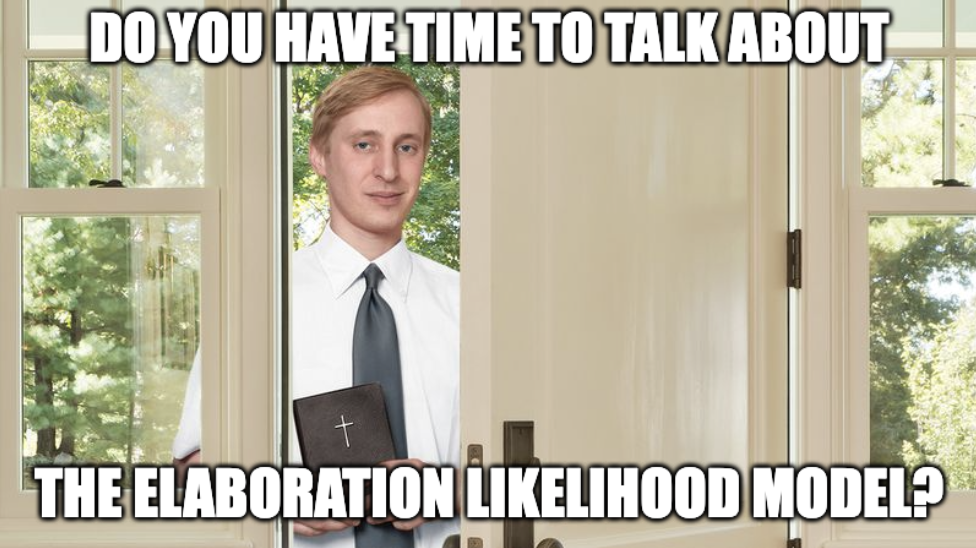
I am very obsessed with the ELM.
Benjamin Wilson
The Elaboration Likelihood Model? or ELM is a model of how human processing works; either through the central route or the peripheral route. Teeeechnically there’s probably a reflexive processing route which involves motor-neural reactions (like touching a hot stove and jerking your hand away faster than you can cognitively process what happened), but that’s not really important for communication, unless you’re writing copy about why hot stoves are bad. But heck, let’s put that into a table so we can compare the three-ish routes of processing;
Central route
Peripheral route
Reflexive route (not canon)
What is it?
You actively think about ideas, facts, and opinions, and integrate your conclusions into your own mental model of reality.
You accept predetermined heuristics and emotional input, making decisions based on intuition and gut feelings.
Your nerves sense danger, causing a reaction before the nerve signal could even reach the brain.
Main mechanism?
Thinking / cognition
Emotion / intuition
Direct nerve reaction
Effects on ownership?
Significant, because the audience makes their own conclusions.
Very little, because another emotion can override the existing one.
Depends on how the experience is processed afterward.
Effects on recall?
Very positive. This causes the brain to make new connections between ideas; literally, integrated into the user’s cognition.
Neutral to slightly positive. Emotional states are often recorded as context by the brain.
Uncertain. I don’t touch hot stoves; there’s probably a correlation.
When to use?
When you need to encourage a behavioral change or teach.
When you need to stimulate a quick, temporary action.
As I’ve written before, I am a person with a high need for cognition, so I prefer to always use the central route - that is, think things through. When someone uses a communication technique that applies the peripheral route - that is, emotional appeals, I become annoyed.
Why the central route is user-centric and the peripheral route is egocentric
The central route of processing is entirely dependent on the user to learn, whereas the peripheral route forces a foregone conclusion on the user. Central route processing is user-centric, because it considers the needs, background, uses, etc., of the user. Peripheral route processing is egocentric because it only considers you, not the other half of the conversation.
Meme
Egocentrism is bad.
Benjamin Wilson
Let’s talk climate change communication. Fear appeals, a long-term favorite of many communicators, do, in fact, create a strong emotional reaction in audiences. However, they don’t spur long-term change. Fear appeals are an example of egocentric communication; they do not consider the user’s circumstances, needs and motivations.
Admittedly, creating messages that help your audiences think through and come to a conclusion is more costly for you as the sender; user-centric messages require more effort on your part. They do, however, lead to better learning and retention, and better ROI over time. A single high-cost message that works vs. hundreds of low-cost messages that don’t; works always gets better ROI than doesn’t work.
Stronger buy-in and less psychological resistance
One-size-fits-all communication is inherently egocentric, often ethnocentric, and in many cases, parochial. Let’s talk about some of these barriers.
Egocentrism
Egocentrism is when you consider yourself first, rather than second. You make a message because it’s the message you want to make, not because it’s the message that your audience wants or needs. Egocentric messaging is inherently selfish and doesn’t consider the needs of the user.
To avoid egocentrism, consider the uses, needs, and motivations of your users. Heck, do a demographic analysis and figure out everything you can about them.
Ethnocentrism
Ethnocentrism is when you judge another culture by the standards and values of your own culture, often believing that your own culture is the superior culture. It is an illusion, and the idea is toxic to communication.
No culture is inherently superior to another culture, because that implies that cultures exist on a fixed path and can only advance in one direction, which the multiplicity of cultures in the world show is not true. And if you have a hard time believing that your own culture isn’t superior to every other culture out there - just go eat. Enjoy the different foods that are available from the multitude of cultures in the world, and see how our differences make for a wonderful world.
To avoid ethnocentrism, pay attention to and recognize the cultures you are speaking with, don’t use insider terminology, and build listening into your strategy. Also, don’t be afraid to ask for help; if you need to communicate with a specific people group, engage someone who understands that people group.
Parochialism or metronormativity
Do you live within ten minutes of a grocery store? Do you have an international airport within an hour of your house? Do you have reliable access to high-speed internet? Do you live within fifteen minutes of an interstate? Congratulations!
Those norms don’t apply to everyone. This is parochialism, or metronormativity. Cognitive blind spots that lead us to believe that if we have something (a positive) then other people will have it t0o, even when they do not (a privative). Privatives are harder to mentally simulate than positives, which might be (citation needed) a reason that this creates cognitive blind spots.
If you are located in DC and you’re writing for an audience in Bozeman, MT., headlines like “The beltway, amirite?” will fall flat. If you are in Texas, writing for an audience in Maine, you might want to avoid things like “It’s Friday, Y’all” in an email bedecked with cacti. If you are in Portland, OR., writing for an audience in Fairbanks, AK., you might not want to discuss how this 30f cold snap is life-threatening.
To avoid parochialism, don’t write based on your own experiences. Understand the needs and experiences of your audience.
More usable and actionable
User-centric writing respects the reader’s time. If you make comms products more scannable, your audience will digest them better, leading to better communication and higher-quality conclusions. This means greater utility for your reader.
BLUF - Bottom Line Up Front:
Putting the most important information at the very beginning - like a press release, for example - gets the idea in the door, even when your audience doesn’t have time for a full read-through.
Action-orientation:
Look, I know you don’t want to be in a dozen meetings arguing nouns and verbs, but; write for actions your audience can take. The title of this post is an example; write for your audience. This allows quick scanning by actions that your audience can perform.
Jargon-free zone:
Jargon does not respect your audience. Jargon is very egocentric. Instead, write for their level of understanding of the subject, and explain technical terms on first use.
Evidence vs. Authority: potential conflict
The elephant in the room here is that many communicators eventually find themselves in a position where an individual in their organization, who is in a position of power, insists that things be done a specific way in spite of all evidence to the contrary that it will not work. I think most of us have dealt with this, at least once.
This is an evidence-based strategy vs hierarchical authority conflict. Let’s map this out in a decision tree.
flowchart TB
Start["COMMUNICATIONS DILEMMA A:Data-Led B:Directive"] -- Choose Strategy A ---> StrategyA["A: Follow the data"]
Start -- Choose Strategy B ---> StrategyB["B: Follow the leader"]
StrategyA -- Outcome: A > B --> Node1["1. Data wins! But you might get fired."]
StrategyA -- Outcome: B > A --> Node2["2. Data loses. Sad face emoji."]
StrategyB -- Outcome: A > B --> Node3["3. Data prevails! Talk to the boss about why data == good."]
StrategyB -- Outcome: B > A --> Node4["4. You were... wrong? Good opportunity to learn."]
Start:::startNode
StrategyA:::strategyA
StrategyB:::strategyB
Node1:::outcome1
Node2:::outcome2
Node3:::outcome3
Node4:::outcome4
classDef startNode stroke:#818cf8,fill:#eef2ff
classDef strategyA stroke:#4ade80,fill:#f0fdf4
classDef strategyB stroke:#fb923c,fill:#fff7ed
classDef outcome1 stroke:#4ade80,fill:#f0fdf4
classDef outcome2 stroke:#f87171,fill:#fef2f2
classDef outcome3 stroke:#facc15,fill:#fefce8
classDef outcome4 stroke:#a78bfa,fill:#f5f3ff
In a basic contractual relationship, where you provide your services in exchange for money, it is extremely rare that you would be given a pat on the back for ignoring your boss. I cannot recommend that course of action. If the data are right, and you can prove that you did a better job by ignoring your boss than by listening to them, you might have a good resume bullet, which you might need because you might also be fired.
On the other hand, if you do what you’re told but document and measure, you can either be right and tell leadership ‘Respectfully, I told you so’ and work on getting them to listen to their subject matter experts (that’s you, by the way), or you might be wrong, and then you have an opportunity to learn and improve. Either way, data == good.
Why write for your audience?
We’ve gone over a half-dozen reasons, some case studies, and a few peer-reviewed journal articles. If that isn’t enough for you - write for your audience because they matter. When ideas are exchanged between parties, we undergo individual social evolution, and that’s what communication is, really; a bunch of people trying to understand each other and exchanging information.
]]>Demographics and media profiles2026-09-18T15:34:00-07:002026-09-18T15:34:00-07:00https://theframeworkfile.com/2026/09/18/demographicsWho is your audience and where do they listen?
We’re going to walk through a practice round of how to identify your audience demographic and where your audience is having their social conversations and consuming media. These are two of the steps in my comms strategy template which I highly recommend to any strategic communicator (I recommend taking these steps, and I also recommend my strategy, but feel free and roll your own), and I’ll provide resources, links, and we’ll build a listening profile as we go along.
If this seems like too much work for a simple ‘ol comms strategy, I disagree; your communications strategy is the core of many actions, and having the best understanding of your users is useful for communications, marketing, and business in general.
The case study
For this particular case study, our brand is called Brass Rule watches.
The brand
They’re a fashion brand that focuses on medium-upscale, handcrafted watches with Swiss movement, focusing on reclaimed and sustainable materials. They have several watches in the $1,000-$1,500 price range. Let’s put some jank AI imagery in here (created by Adobe Firefly, so they aren’t plagiarized, just low-effort) to simulate some of these products, because I can’t be bothered to become a master watchmaker in order to make a case study.
Fake photo
Two watches.
Benjamin Wilson
There you have it, Brass Rule watches. We have two nice watches here: one for large wrists and one for small wrists. Brass Rule doesn’t gender their watches, so they don’t use ‘men’ and ‘women’; they also feel that this will be a good move for future expansion into APAC regions, where wrists tend to be smaller than they are in North America and Europe. Right now, Brass Rule distributes online and in-person, but their online model is store fullfillment out of their Akron, Ohio, brick-and-mortar storefront, where they also handcraft their timepieces out of mushroom leather and marine brass, fitting in the precise Swiss movement.
Brass Rule likes to handle returns in-person, because they fancy themselves as an artisanal business. They don’t want an impersonal experience; they want returns to be a conversation, so they can help people find the right artisanal timepiece that they’ll love and give to their grandchildren (or nieces and nephews if they don’t have grandchildren). This naturally limits the distribution radius; people can shop further out, but the in-person nature of returns will have a chilling effect on far-flung purchases, even if it doesn’t impact local purchases.
The audience
Hopefully, Brass Rule knows their audience demographics fairly well, because they’re slinging watches at ten to fifteen bills a pop. We don’t know who their audience is, though, so we’ll have to do a little digging.
Watches are a high touch, tactile shopping experience, and e-com returns average 24.5%, which reinforces the geographic limitations of their shopping. We’re probably looking at a geographic range of about 20 minutes. They may have the occasional purchase in Canton, but they won’t see a lot from Cleveland. Pittsburgh and Columbus are right out.
Why does this matter? The context establishes the geographic bounds for our demographics, and the product pricing stratifies it a little further. If we look at our geographic area, we can start to make a couple of profiles. Here’s our blank table that we can start filling in;
Group name
Age range
Income
Purchasing factors
Area
We’re looking at an entry-level luxury watch which maps well onto a real-world watch like a Zodiac or the occasional Omega. These are typically a purchase of around 1% of the annual salary for an aspirational buyer, or a knockaround watch for a casual buyer. Hobbyists - horologists - might also prize them for their craftsmanship, but would have a lower general income than either of the first two. So we have $1k x 100 for our core demographic, $1k x 150 for our casual demographic, and maybe $1k x 75 for our horologist demographic - they’re probably looking at Klarna or Affirm to afford entry-level luxury timepieces. Let’s put that data in;
Group name
Age range
Income
Purchasing factors
Area
Aspirational
$75k-$150k
Affordable luxury.
Casual
$150k-$250k
Something to wear to tennis.
Horologist
$50k-$75k
Appreciates the craftsmanship.
Now we’re getting somewhere. Let’s do a little research on who makes that kind of money near Akron.
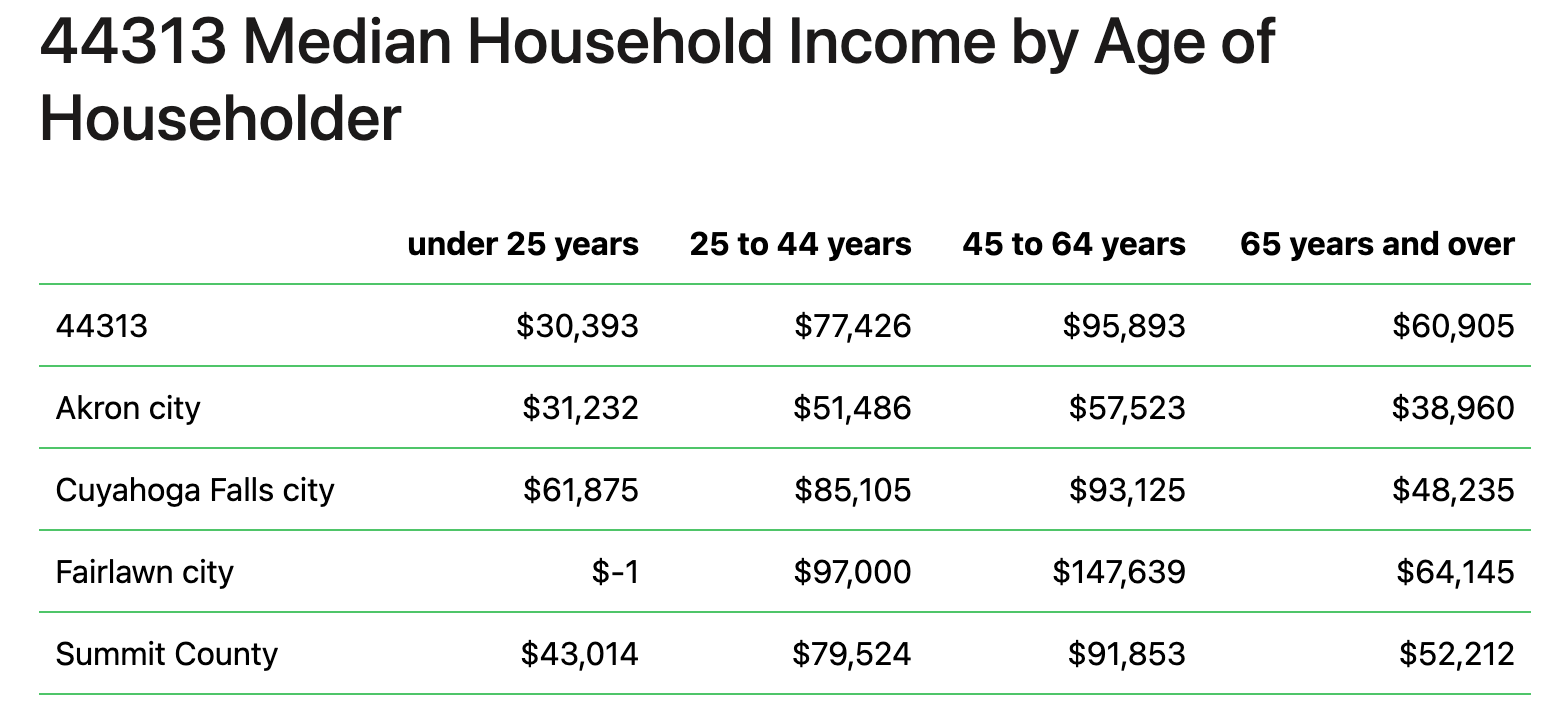
Married families in Akron are earning right around our Aspirational group’s sweet spot, but non-families really aren’t. This means we’re looking at a much tighter geographic area for where our groups are located. The horologist group is probably good, though.
Casual buyers aren’t as common in Akron (or in most places), but Fairlawn has a median income in the 45-64 age range of $147,639, so that means there are people making above the median. We could dig deeper; if you’re doing this for work, I recommend digging deeper.
Hobbyists seem pretty likely to be in the 25-64 group in Akron city, with a median income of between $51k and $57k, or elsewhere. These won’t be the most common buyers, but they’ll make up a percentage.
Let’s take all that and fill in the table.
Group name
Age range
Income
Purchasing factors
Area
Aspirational A
30-45
$75k-$150k
Affordable luxury.
NW Akron, Fairlawn
Aspirational B
45-64
$75k-$150k
Hands-on experience, tactility.
NW Akron, Fairlawn
Casual
45-64
$150k-$250k
Something to wear to tennis.
Fairlawn
Horologist
25-64
$50k-$75k
Appreciates the craftsmanship.
Akron City
This is a pretty good start. Even I’d call this a good start, and I love to overdo things.
Where are they listening?
You can very easily be tempted to generalize age ranges to social media platforms, and that’s honestly not a bad way to go. That’s burned me before, so let’s take a look at the electromagnetic spectrum and the mass media outlets that are available, because we want to know about internet penetration, mobile access, and which mass media we can blast out with. Know which tools are in your toolbox. That’s actually a really good quote;
Know which tools are in your toolbox.
-Ben Wilson
Why is this important? Are you going to use SMS? Geofencing? Do you want to keep in touch with people via text? Are you hyper-segmenting? Lots of reasons to know what media you can and cannot use. Don’t be like that one orange big box store chain and force geofencing while inside of a giant steel structure that acts as a Farraday cage and attenuates signal, so the geofencing is essentially useless; know where the dead zones are.
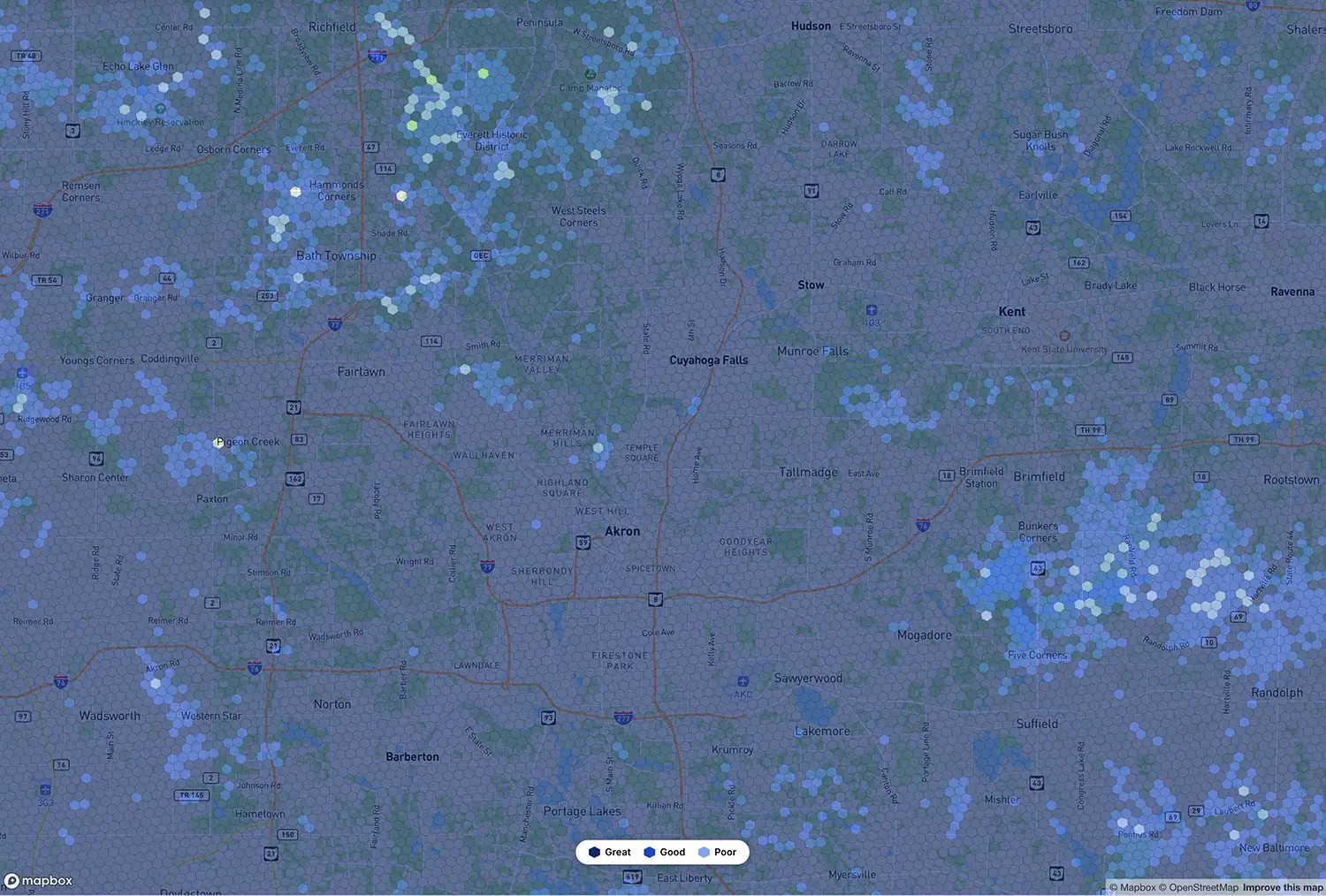
Coverage map of Akron and environs
coveragemap.com
Social media usage by platform
Pew Research Center
Akron has, predictably, pretty good coverage, but there are some nearly-dead pockets near Fairlawn, where the majority of our target demographics live. Looking at the overlay, those are highly wooded areas, which might also map to larger properties or properties that have more space between them, i.e., valuable residential real estate. Takeaway: don’t rely on SMS, but it’s probably a solid tool.
This is a good time to start our second table: channels. I’m omitting most of the sources for this one, but you can dig them up. There are so many. Here’s a solid set of steps you can take;
Ask Gemini or Claude for sources that correlate your audience with channels
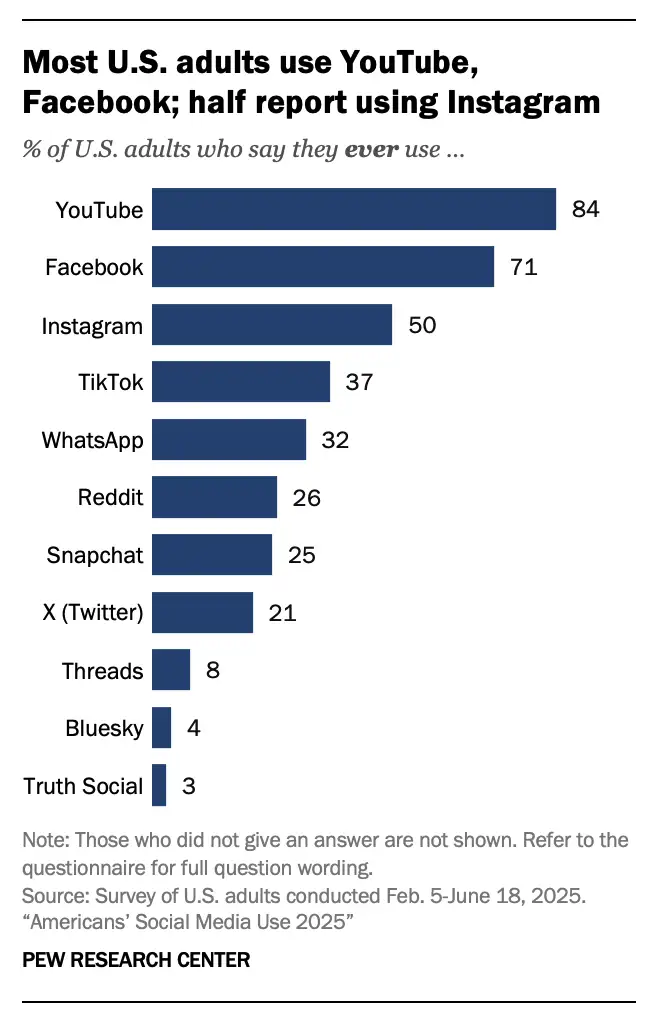
I’m going to very, very briefly dive into the last one; the Pew Social Media Fact Sheet. A few years back, YouTube began to overtake Facebook as the primary platform for U.S. Adults. Right now, 84% of U.S. Adults say they use YouTube, compared to 71% for FB. Insta is at 50%. The data also show which age groups use which platforms. Although we can’t say that this is the exact mapping of demographics to channels for Brass Rule’s audiences, specifically, this is a very, very good, empirical dataset.
Let’s plot that all out in a table;
Channel
Type
Demographic
Strengths
Feedback
Akron Beacon Journal
Newspaper
Aspirational B
4-time Pulitzer-winning. Strong journalism.
Low
Signal Akron
Online news
Aspirational A
Non-profit digital news. Younger urban skew.
Medium
The Reporter
Newspaper
African-American community
Strong community ties
Low-Medium
WKSU
Radio - NPR
Aspirational A, B, Casual, Horologist
NPR affiliation, and targets our demos specifically
Low
WONE
Radio - Classic rock
Aspirational B, Casual, Horologist
Targets Gen X.
Low
LinkedIn
Social Media
Aspirational A, B, Casual, Horologist
Business-focused, would work well for upwardly mobile professionals, also a utility for the 45-60 crowd
High
Instagram
Social Media
Aspirational A, Casual, Horologist (30-45 age ranges)
Visual discovery; show nice watches. This is an influence channel, with some buy potential.
High
Reddit
Social Media
Aspirational A, Casual, Horologist (30-45 age ranges)
r/akron and r/Watches are gold for this, but avoid shills. They are a huge risk.
Highest
YouTube
Social Media
Aspirational A, B, Casual, Horologist
UGC and influencers have a lot of weight with all of our demos.
High
Facebook
Social Media
Aspirational B, Casual
Daily destination for these demos. They track marketplace, watch local businesses, and follow community pages.
High
We’ve established our demographics and their channels; now, you can make media connections, formulate some witty Insta captions, and contact some creators. Everything’s great, except for that whole problem with in-person-return friction. That’s going to rub our Aspirational A group the wrong way; they really like e-com.
The elephant in the room
This is probably one of those times when, as a communications manager, strategist, director, or whatever your title is - you might want to talk to your client/boss. Your research shows that they’re probably leaving a lot of money on the table with that in-person-only policy. If you saw conversations on Reddit about it, those are good material to bring with you; show actual, qualitative examples of user dissatisfaction or distrust.
That’s called issues management, and it’s an incredibly important skill to have. If you see something brewing, don’t let it blindside the boss; bring it up. Maybe you won’t be able to tie the increase in revenue to your communications strategy, because it was the result of an in-person meeting, or maybe you’re very clever and you can show that via incremental attribution (that’s a marketing tactic; the non-marketing side of comms rarely uses it). Either way, if you can make your employer more money, they should be happier.
At the very least, they’ll be unhappy, with full pockets, and a really good demographic analysis.
]]>Simplicity2026-09-18T09:31:00-07:002026-09-18T09:31:00-07:00https://theframeworkfile.com/2026/09/18/simplicityQuality is a strange concept. As a data-minded person, I believe that quality is a categorical thing that refers to qualitatives or qualitative data; it is descriptive. It can be positive, negative, or simply the equivalent of metadata; data about data. Robert M. Pirsig struggled with the idea of quality for many years, however. He believed it was something metaphysical that was neither subjective nor objective, but a third type of thing that precedes rational thought. After reading Zen and the art of Motorcycle Maintenance and On Quality, I was presented with the idea that quality might not be as simple as I believe. How can something that is simple become not-simple with the presentation of additional information?
Simplicity
That’s the problem. Simplicity isn’t simple for everyone. Nothing is simple for everyone. Simplicity isn’t universal.
Simplicity is a psychological state that is highly coupled with understanding.
Daniel Faltesek, Oregon State University
Have you ever created a thing - let’s say a design - and submitted it to your boss, who told you to ‘make it more simple’? How difficult was that to achieve? It wasn’t simple, right? I’m inclined to say that simplicity doesn’t really exist, except it exists psychologically. Simplicity is something that is very real to each of us; the problem is that it isn’t defined the same way across different people (TL;dr - want to know how to bypass simplicity and all that jazz, and just make a comms strat that works?).
Infographic
Simplicity isn't universal.
Benjamin Wilson
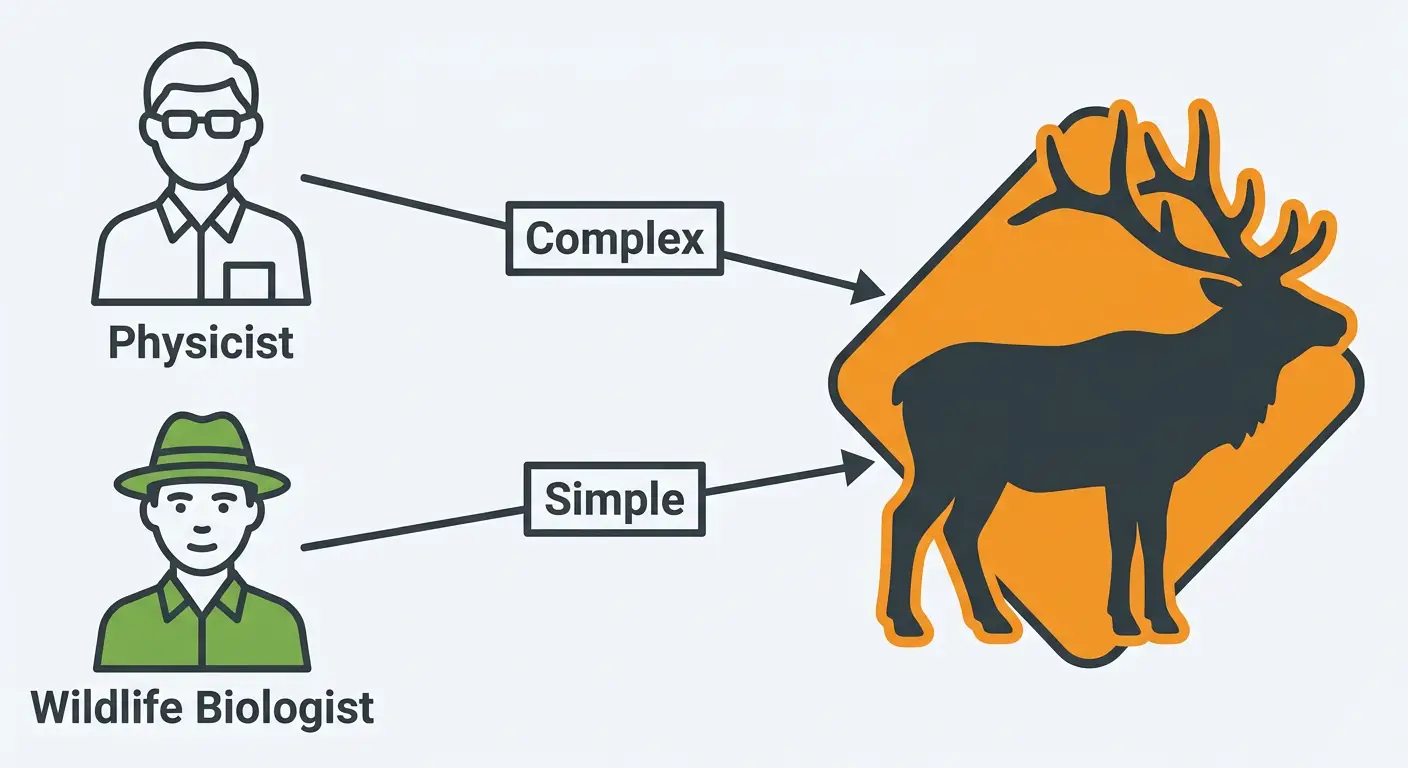
Take two individuals with two backgrounds, two different sets of experiences, and two different fields of education. If one is a Physics major and the other is a Wildlife Biology major, it is far more likely that the Physics major will understand concepts about the probability of particle positions and velocities than the Wildlife Biology major. Similarly, the Wildlife Biology major is more likely to understand the habits of Rocky Mountain Elk. To each, different things are simple, based on their psychological states and understandings, and I would say, their respective contexts and backgrounds.
Complexity
Oddly enough, complexity seems to be relatively easy to define (or it seems simple to me, at least :D ). Take a system with very few parts. A watch face is a great example. Add more things. The system becomes more complex. Apple calls them ‘complications’, which is really cool because it’s accurate and portrays a deep understanding of the concept.
I think most people would agree that adding complications to a thing increases the complexity. I wouldn’t disagree. The difficult part here is; if adding complications increases complexity, does removing complications increase simplicity? Furthermore, how much simplification is required in order to reach something that is simple? I don’t think it’s quite that easy, unfortunately. Rendering things in terms of complex and simple paints the world as a number line, simple on one side and complex on the other. I don’t think that’s how it works.
Simplicity seems like it is a privative, rather than a qualitative attribute. Privatives are things that we have concepts for, but don’t exist, like holes, or dark, or cold. There are no physical things that define cold; cold is simply the absence of heat. Dark is simply the absence of light. Is simplicity the absence of complexity?
Probably not. I think Dan Faltesek is right, here. I think simplicity is internal, and is a psychological state that occurs when your knowledge and understanding are able to accurately interpret the state of a system.
Category
Concept
What is it?
How it is measured?
Is it universal?
Is it real?
Privative
Cold
The absence of thermodynamic energy.
A decline in thermometer readings; a loss of energy.
Mostly. Preferences for temperatures vary, but changes in temperature are mostly universally felt.
Is it real? Not exactly.
Positive
Heat
Thermodynamic energy.
An increase in thermometer readings, or an addition of energy.
Yes, heat is universal.
Heat is energy and is a real thing.
Privative
Dark
The absence of light.
Oddly enough, you can measure darkness on a ‘Sky quality meter’ which outputs magnitude per arc-second of light, which you can translate into the Bortle scale of darkness.
Yes, darkness is universal with exceptions for differently-sighted individuals.
No, darkness isn’t real, even if it is measurable.
Positive
Light
Photons, which exhibit wave-particle dualism.
Light meters measure in many different scales, but typically as photon impacts on a sensor, expressed in a given scale. Ask your local hydroponic shop, they’ll tell you.
Yes, light is universal. It is the speed limit of the universe.
Yes. Light is one of the most real things that exists.
Psychological state
Simplicity
A state where an observer’s background allows interpretation of a system.
Internal comprehension and context
No, simplicity is not universal.
Subjective. What is simple to one is opaque to another.
Psychological state
Complexity
The density of components in a system.
By the number of complications in a system.
No, complexity is not universal - but it is easy to mentally simulate.
Objective but not measurable: you can count components, but you can’t count cognitive load.
There’s probably a Dunning-Kruger dimension to it, as well; when you understand more, you understand the depth of what you still do not understand, which makes things even less simple. This is what plagued Pirsig; the more he learned, the less he knew. It seems counterintuitive that additional knowledge can decrease knowledge, and it doesn’t, exactly. Adding additional knowledge on a subject creates an awareness that there is yet more to be learned about that subject, which is how learning more about something that is simple can result in what was simple becoming complex. The additional knowledge creates a different understanding, and changes your psychological state.
Understanding
Simplicity as a psychological state; that’s a really interesting thing to think. When I first started attending Oregon State University, I got into a few of Prof. Dan Faltesek’s lectures, and he had these really interesting ways to say things - things like “What is the meaning of video games?” And the idea that the anger and furor that result from social media are “Interest”, and that the word “Interesting” doesn’t mean that something is good, just that it generates interest, which is the feeling of curiosity or attention toward something. And that the word “Important” doesn’t mean positive things, necessarily. HIV is an important part of the AIDS epidemic; that doesn’t make it positive. It carries great import, great significance. In these cases, understanding the dictionary meanings (read: actual meanings) of these words makes certain concepts more simple; a logical proof that simplicity is a psychological state.
Learning about media theory, communications theory, and theories of power, responsibility, surveillance, civics - all of these things contributed greatly to my own background, eventually integrating into my own psychological state. This means that if someone wants to talk about things like panopticonism, bits of entropy, signal-noise ratios, society building, or identity performance, all of those are relatively simple for me to understand.
Here’s an example. Did you know you can use an Ulu to skin a caribou? I didn’t. I learned this in rural Alaska.
There are so many parts to the mechanics of hunting and subsistence that seem simple to someone who knows how, and knows what all of those things are. It is simple once you know, or it is simple once you’ve thought about it; we often say these things when presented with new ideas. Adding to your knowledge and understanding increases the amount of things that you might consider to be simple. But if you don’t know what an Ulu is, don’t understand the difference between a caribou and a reindeer, and don’t understand why people in rural Alaska hunt for subsistence, let alone the social facets of not living on the road system, what the road system is, and that subsistence is a large part of life for many Americans - none of these things are simple.
Universality
The complex part about simplicity is that we all possess a concept of it, and we all live within our own heads. We all tend to believe that the things we think are the same things that everyone else thinks. This is known as egocentric bias, which is one of the most poisonous traps you can fall into as a professional communicator. In the case of people not from rural Alaska not understanding the pressures of life in rural Alaska, there’s also a great deal of ethnocentrism in play, which is another deadly trap for communicators. Your experience is not my experience. My experience is not my audience’s experience.
Applying this to real life
If we can’t understand what is simple for someone else, how can we possibly hope to communicate with them?
Fortunately, the idea of universal simplicity isn’t necessary for clear communication. What we need to do as communicators is to empathize, find effective ways to communicate with the other part of the communication cycle, and to listen for what they have to say. There is a system for how to avoid the simplicity trap: just sidestep it entirely, and try to understand the other conversant.
Avoid using insider jargon - it will exclude anyone who isn’t in your group.
Avoid creating barriers to understanding (insults, slights, marginalizations).
Avoid trying to adopt the slang of the group you’re trying to talk to. It will ring as non-genuine and create more noise.
Listen for what is important to your audience.
Listen for your audience’s needs.
Don’t just wait for the other party to stop before you blast out another message; take the time to interpret the meaning of what was said.
The interesting thing about communication is that it is an active endeavor on both sides; you try to encode your meaning into your message, and the receiver tries to decode your meaning. They aren’t passive receivers; they actively try to understand what you mean, so you need to actively try to make a message that your audience will understand.
Does that sound simple? Probably not. It probably sounds like work. But that’s okay; nothing in life is universally simple. Just try, and others will try, and then improve your approach through learning. As long as you aren’t flinging mindless press releases and tone-deaf tweets into the void, it’ll probably end up right in the end.
]]>Nouns and Verbs2026-09-17T00:00:00-07:002026-09-17T00:00:00-07:00https://theframeworkfile.com/2026/09/17/nouns-and-verbsI’m a huge fan of overdoing things, but you really have to know when it’s okay to go over the top. Sometimes you need a little extra. Most of the time, you need to know how to achieve the right balance of inputs and outputs.
I was on a project where I was working under someone else’s communications strategy. Now, this is always a point of tension - if you’re the person with the comms strategy, you know that everyone else who creates strategies will have small criticisms, and if you’re not the originator, you’ll have lots of small criticisms. Mostly we professionals just get along all hunky-dory and don’t cause tension, of course. Sometimes, though…
Stock photo
I prefer Roget's or Merriam Webster's, myself.
Benjamin Wilson
Nouns and verbs
This particular project involved getting rid of six old paper forms and replacing them with one new, shiny, web-based form. Since I generally dislike forms, I found the logic behind the project to be impeccable. Let us reduce the amount of forms in the world, says I. Nunquam ponenda est pluralitas sine necessitate, says William of Ockham. Although simplicity isn’t a universal thing - it is highly tied to individual psychological states, and what is simple for one person will not be simple for another - in general, reducing things that increase complexity will cause an increase in simplicity. This is an interesting paradox; if you can’t define simplicity, how can you increase it? I don’t know. I’ll explore that some other timeI explore that in my post about simplicity.
All that being said, the project required a lot of communication. Lots of people used these forms, so it makes sense that there would need to be a strategic plan to get lots of people who currently use lots of old forms to become lots of people who use new, streamlined forms.
How you would have done it
Here’s how I would have made this strategy - probably how you would have, too;
Formulate a problem statement (old forms, cause lots of old form problems)
Figure out what we’re going to do about it (shiny new form, fix old problems)
Figure out who it affects and do a demographic analysis
Figure out the best way to tell them that things, they are a’changin
Come up with core messages
Push core messages on multiple channels (website and social media)
Deploy.
For bonus material, I would set up a two-step strategy where you push out an initial round of messages, saying “Hey, these old things are going away, try this new thing!”, and run that for about two to four months before deleting any mention of the old ones. And for bonus bonus, set up a UTM scheme that would allow you to discriminate between clicks going to the new form and the old form, and set that up as part of my feedback step. You can measure it, so you can prove it.
How it was done
Uh, so instead, the three people in charge of this particular comms strategy held a series of about a dozen meetings arguing over nouns and verbs.
No, really. It sounds like hyperbole, but the actual, real-deal-holyfield, honest truth is that the meetings involved two waves;
They who were in charge of the project argued over when the noun form on the page - file an application, for example - could be changed to the verb form - apply.
They who were in charge then set up meetings to argue with other people about verb and noun forms.
Number of meetings about communications products: 0
Number of meetings about key messages: 0
Number of meetings about the company bottom line: 0
Number of meetings about the users: 0
🤔
At no point were users mentioned, at no point were channels mentioned, and there were no success metrics involved. This doesn’t fit my definition of a comms plan. Any communications plan which doesn’t think user-first is inherently selfish, and won’t ever reach maximum efficiency, because you can’t iterate; there’s no feedback to base iterations off of. As a guest on the project, it was difficult to not jump in and say “You’re doing it all wrong,” but one must have manners.
The impact of the project was generally a lot of redoing things after the fact, a lot of missed communication, and I’d bet a lot of angry users.
Diminishing returns and getting lost in the details
It’s easy to point out a trainwreck of a project like that and say “obviously, everything about that was wrong”, which is what makes it perfect for a rhetorical device. It actually happened, though.
Sketched graph
The law of diminishing returns in a beautiful sketch
Benjamin Wilson
The hidden fault of that method is getting lost in details. Writing-focused communicators are famous for getting lost in the details, justifying their actions with phrases like “words matter”, which is correct in essence if not in application. When you get lost in the details, you end up spending a lot of cycles trying to accomplish very little.
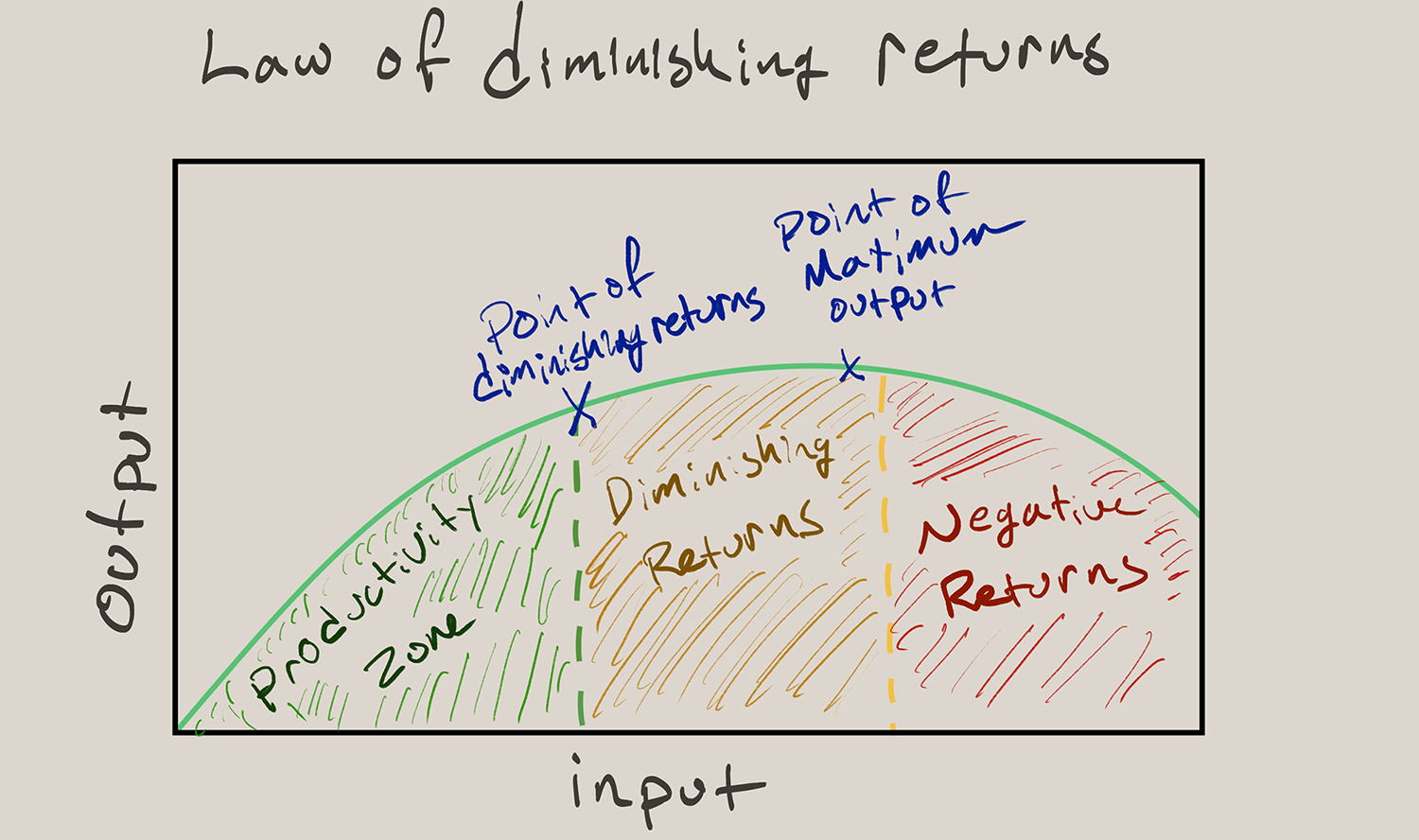
The law of diminishing returns isn’t actually a law, it’s more of a principle. The idea is that, up until a certain point, your inputs and outputs are nearly at a 1:1 ratio, which means that you’re very efficient. If you design your strategy in such a way that you stop when you reach the apex of this portion of the curve, you achieve maximum productivity. This is where you should aim for in about 80% of situations. Sometimes, though, the thing you’re trying to accomplish needs a little extra. That’s when it’s totally okay to go over the top.
If you keep going, you’ll experience diminishing returns - less return on investment. Your total return will keep increasing until a certain point, though, and for a small percentage of the time, you need that extra output. Prestige projects are like that; you just need a really good return. Portfolio projects, too.
If you keep putting in effort, though, you’ll experience negative returns on investment. Putting in more effort - scheduling more meetings about nouns and verbs - won’t get a better product, it’ll yield a worse product. If you keep putting in more effort, you’ll often lose staff and receive the benefits of disciplinary action. I generally don’t recommend.
Perfection is inherently selfish
I’m a perfectionist by nature. I like spending time to create increasingly finer products, often at the cost of my own productivity. People like me often put in far too much effort for far too little product. In the end, though, you do it because it really, really feeds your pride.
You don’t focus on perfection because it helps the other side of the conversation; the user. It doesn’t. From a user-focused perspective, perfection is the moment when you have a solution that meets their needs. This is a fixed point that can be achieved, not a curve of increasingly perfect products.
That’s why perfection is inherently selfish; it doesn’t focus on whether the user has their need met. Any communications campaign which strives to achieve perfection, rather than meeting a need, is always going to end up in the negative returns side of my hand-drawn figure.
Perfection is Zeno’s paradox (not the literal paradoxes which deal with infinitely dividing space into smaller spaces, but the metaphorical one which deals with a concept that you can approach but never reach); you can approach it, and you can keep approaching it, but you can never achieve it. You’ll always end up in diminishing returns territory.
Caring about the other side of the communication cycle - the user - means that you have an honestly achievable goal. It may be a big goal, but you can achieve it.
And if that isn’t enough to satisfy you, at least you won’t end up in a dozen meetings about nouns and verbs.
]]>A communications strategy template2026-09-16T00:00:00-07:002026-09-16T00:00:00-07:00https://theframeworkfile.com/2026/09/16/strategy-templateThis is a free template for a communications strategy. You can download it , and you don’t have to sign up for anything. I’ll explain how to fill the whole thing out.
How do you make a communications strategy?
You can go large, you can go small. I prefer this chonkier format because it covers everything you’ll need in a topical list. I’ve seen a lot of comms plans without a demographic analysis (an audience section) and I highly recommend that you always perform a demographic analysis, even if you cut out some of the other stuff. At the very least, port in an older one. Shouting to an empty room will always yield lower ROI than conversing with a highly engaged audience. Plus, comms plans without considering the other side of the comms cycle are doomed to failure (evidence-based opinion), along with favoring self-centered messages and being blind to the people you’re affecting.
Communications Strategy Format
A guide to the sections of my preferred comms strategy format.
flowchart TD
    A["Summary"]
    B["Situation"]
    C["Objectives"]
    D["Audience"]
    E["Core messages"]
    F["Channel map"]
    G["Action plan"]
    H["Feedback and analytics"]
    I["Risks and contingencies"]
    J["Resources"]

    A --> B --> C --> D --> E --> F --> G --> H --> I --> J

    classDef foundation fill:#dbeafe,stroke:#2563eb,color:#1e3a8a,stroke-width:2px;
    classDef strategy fill:#ede9fe,stroke:#7c3aed,color:#4c1d95,stroke-width:2px;
    classDef execution fill:#ffedd5,stroke:#ea580c,color:#7c2d12,stroke-width:2px;
    classDef evaluation fill:#dcfce7,stroke:#16a34a,color:#14532d,stroke-width:2px;
    classDef risk fill:#fee2e2,stroke:#dc2626,color:#7f1d1d,stroke-width:2px;

    class A,B foundation;
    class C,D,E strategy;
    class F,G execution;
    class H evaluation;
    class I risk;
Write this last. An executive should be able to read an Executive Summary and make a decision, so it needs your important data points in it. My preference: 30 seconds of read time, answer who, what, and why. Aim for no more than a paragraph for the key points, three supporting bullet points, and one supporting paragraph. Tie paragraph one and your bullet points to business objectives or KPIs.
Tip: click any section in the diagram to load its details here. Edit the "details" object in the script to make this your own.
Strategy doc
Downloadable template
If you want to cut to the chase, here's a word version. This is intentionally bare-bones and structural; you adapt it to your own branding or dress it up as much as you need.
I recommend personalization. You can always credit me to your boss if you want, but I don't require it. I'm distributing this under the CC-BY-SA 4.0 license.
Building the template into the real thing
I recommend an audience-centered, asynchronous approach to filling out your comms plan:
Situation
Objectives
Feedback and analytics
Audience
Channel map
Core messages
Action plan
Risks and contingencies
Summary
-add any pertinent data to resources any time it shows up. You'll be revising this plan continually; I don't think I've ever seen a plan work seen a plan function beyond the first couple of planning meetings if it was intended to live as a static document. Assume it is a living document; it might even help to introduce it as a living document, so your partners expect changes. Version control is on you, though; you might want to keep a draft copy and a regularly updated copy, but you don't want a comms plan that's full of tracked changes. That feels very writerly, but it is unorganized chaos.
Situation
The situation section should contain;
Background A succinct breakdown of the context and background of what you're trying to do here. This provides why you're doing what you're doing.
State the core problem - don't state a solution in the problem statement.
Substantiate it with some kind of proof, preferably a number.
Close the problem statement with why it matters to us.
Opportunity Potentially favorable conditions that could be a competitive advantage. Market research may be helpful, or social research. Depends on what you're doing.
Risks Kind-of the opposite of opportunities; these are potentially unfavorable conditions that could lead to a loss of competitive advantage, or harm.
Key metrics "You can only improve what you can measure." Buuuut, don't just SWAG this; this is a great opportunity to tie the comms plan directly to the company bottom line. The more accurate you are, the more you can point at it in the future and say "Look, we did a thing."
Challenges What things will make it difficult to accomplish your goals?
Objectives
I like to break this down into two sections; Goals and Objectives. Goals are broad, abstract, sometimes qualitative statements on what you hope to achieve. Objectives are more detailed, often quantitative steps to achieve that desired abstract state.
Examples:
Goal: Increase brand loyalty and mind share in the 25-34, upper middle class demographic in the north Denver area.
Objective: Increase followers in the area by 11-13% Y-o-Y and increase engagement rates by 1%.
Note that you don't provide a solution or road map here. This is just the objective/goal segment.
Feedback and analytics
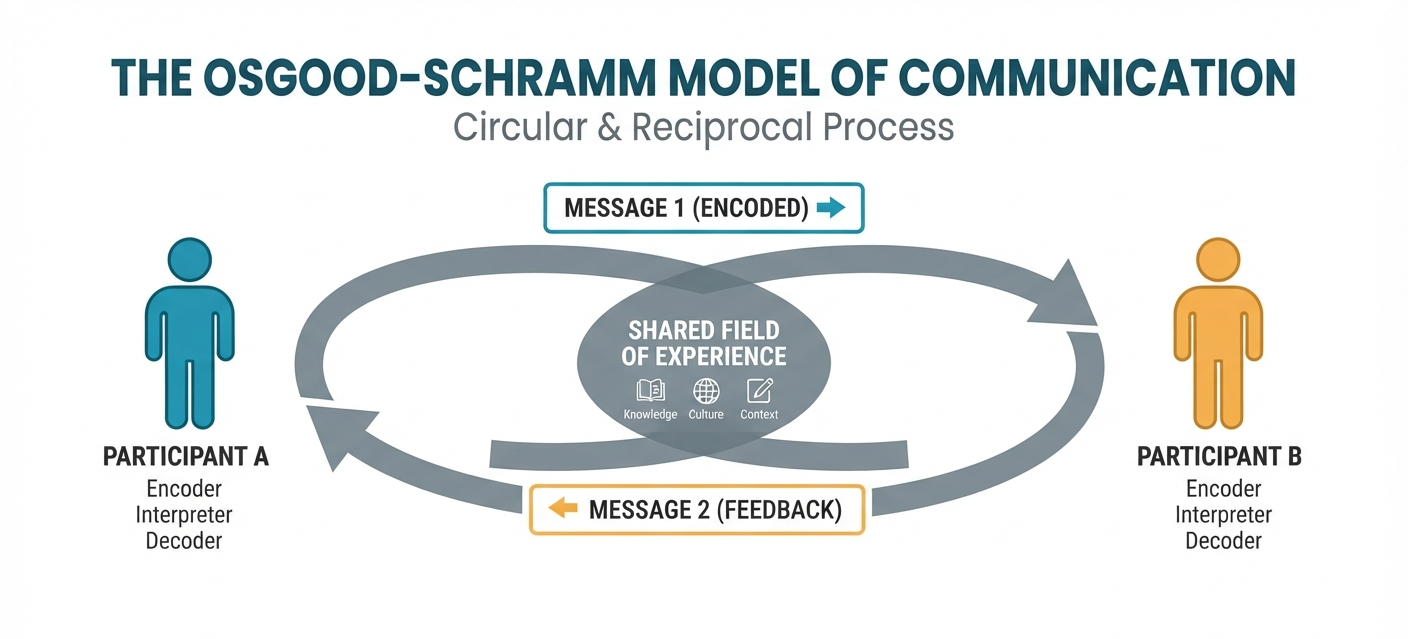
How do you know that you're doing a good job? This is a good time to dust off your communication models. Specifically, I favor the Osgood-Schramm model for this one:
Infographic
Osgood-Schramm model
By Ben Wilson
You, Participant A, encode information to Participant B, who decodes it, then replies in a feedback loop. This tells you some things;
If your strategy is working
How your strategy is affecting emotions and actions
If there are any potential risks on the road (This is called issues management)
That type of feedback provides qualitative data, which is incredibly useful but hard to count. For that, you need quantitative data - Google Analytics, Social analytics, Sentiment analysis numbers, conversions, sales, whatever. Come up with a way to collect all of that data in one place, if you don't already have one. It can be a spreadsheet, a smartsheet, a dashboard, an airtable base, Notion, Qualtrics, whatever. Just put it all in one spot so you can make pretty visualizations for your reports later.
Last but not least:
When you're looking at the entire thing later, don't forget to combine your qualitative and quantitative, and get some insights out of it. 13.1M users in a day means nothing. 13.1M users in one day, followed by 15M users the next, followed by a weekend of +$1M sales W-o-W can make an insight.
Audience
Do a proper analysis of the other humans you're talking to. Seriously. If you know who you're talking to, you can determine where they're listening and how to talk to them.
Ignoring your audience means losing 1/2 of the value of the conversation. You're putting in the effort to make a comms plan, do it right.
Channel map
Since you defined your audience, you can figure out what channels to use. Some considerations:
Are there publicly available data which show the channels and devices your demographic favors?
Are there political or geographic boundaries that affect which channels penetrate in their area?
Are there any geopolitical considerations that would affect which channels to use?
Are there any physical barriers that would affect which channels? I've worked with audiences in geographic areas that had no internet, television, or radio penetration. Not all audiences are the same or have the same access.
Are there other audiences in the channel or area that you need to be aware of, other than your intended audience?
Do you have segmentation capabilities to restrict delivery to only one audience?
Be aware of context and noise in your chosen channels. Context is typically cultural, sometimes microcultural; a certain acronym on Reddit may not carry the same meaning on Facebook. Noise is, well, anything that could interfere with your message being decoded accurately enough to elicit the desired action. Psychological, historic, and linguistic barriers are examples of things that can interfere.
Core messages
Put lists of talking points, key messages, and Q&A in here.
Is there a chance that anyone in your organization might be a point of contact for the press? If so, put info for press contact cards in here. If you aren't the person who educates your staff on press contact protocols, just tell that person that you have some press Q&A content for them.
Action plan
This section needs to have a plan of action and a timeline, and it's not a bad idea to put deliverables in here. It doesn't need to be a full-fledged project plan, but some general ideas are fine. Write it with room for flexibility. I favor open, editable formats for the timeline; tables, sheets, smart art, whatever.
Risks and contingencies
Put on your red team hat, and think of what could cause your strategy to break down. Then, come up with ways to prevent those events from occurring.
Pro Tip: Want to be fancy? Assign a three color scale to each risk:
Green for low risk, things that are unlikely to stop the strategy
Amber for medium risk, things that can stop the strategy but not harm the business
Red for high risk, things that can harm the business
If you're mapping your risks in a spreadsheet or a table, it's usually pretty easy to set conditional formatting. You can also use a block character like █ and change the text color. You can sacrifice amber and go for eye-gouging yellow if you just use highligher á la Word.
Summary
There are a number of formats for writing summaries. You want to write a shorter, punchier summary for an executive, and a longer, detailed summary for an operational audience. I like this format:
Introductory paragraph: No more than 20-30 seconds of read time. Aim for 100 words, with the key points.
Up to 3 bullets: Pick the 2-3 biggest supporting points of data.
Supporting paragraphs: I try to limit to 1-2. Projected benefits and timeline are good options here; if you need a 3rd, you could summarize your strategy and goals, then do benefits, then do timeline.
Sometimes an executive summary can be as long as a page; you know your audience best. Respect their time, though; if you catch someone in a hallway or between Teams meetings, they should have all the info they need to make a decision in about 30 seconds. Elevator pitch, not master's thesis.
Want the template?
Here is the template in .docx format. I recommend personalization. You can always credit me to your boss if you want, but I don't require it. I'm distributing this under the CC-BY-SA 4.0 license. Have fun, enjoy the challenge, and make the world a better place.
]]>Hacking into problems2026-09-15T00:00:00-07:002026-09-15T00:00:00-07:00https://theframeworkfile.com/2026/09/15/foundationsAs a kid, I was great at taking things apart, and not so great at putting them back together. This taught me about cascade failures. No one tells you, as a child, that you can have a career that involves breaking things, and a lot of career professionals wouldn’t describe their jobs that way. However, most things can be broken, and problems are especially vulnerable to breakage. Thus, I describe part of my job as breaking problems.
My take: Don’t fix problems; hack into them instead. Be a system breaker. Then, create a functional system; your desired end state. Here’s a handy interactive decision tree built with Mermaid JS to guide you through how I do things.
Build or break?
Click any box for explanatory deets in the context box.
flowchart TD
    A["New thing or old thing?"]
    B["New"]
    C["New strategy"]
    D["Old"]
    E["Is there a problem?"]
    F["Yes"]
    G["Reverse engineer
 the problem"]
    I["No"]
    J["Revise
 strategy"]
    K["Not yet"]
    L["Target the
 weakest link"]
    M["Deploy"]

    A --> B
    A --> D
    B -----> C
    D --> E
    E --> I
    E --> F
    E --> K
    K --> G
    F --> G
    G --> L
    I ---> J
    L --> M
    C --> M
    J --> M

    classDef decision fill:#ede9fe,stroke:#7c3aed,color:#4c1d95,stroke-width:2px;
    classDef branch fill:#fef9c3,stroke:#ca8a04,color:#713f12,stroke-width:1.5px;
    classDef method fill:#ffedd5,stroke:#ea580c,color:#7c2d12,stroke-width:2px;
    classDef newOutcome fill:#dbeafe,stroke:#2563eb,color:#1e3a8a,stroke-width:2px;
    classDef deconstructOutcome fill:#fee2e2,stroke:#dc2626,color:#7f1d1d,stroke-width:2px;
    classDef reviseOutcome fill:#dcfce7,stroke:#16a34a,color:#14532d,stroke-width:2px;

    class A,E decision;
    class B,D,F,I,K branch;
    class L method;
    class C,J,G newOutcome;
    class H deconstructOutcome;
    class M reviseOutcome;
New thing or old thing?
New things - product launches, brand new campaigns, or anything that hasn't been done before. Old things - something that has been done before, whether it works or doesn't work. This includes projects that didn't get off the ground and implementations that ran into issues.
Break the problem, then replace
The key behind this whole idea is that finding a way to destabilize a problem system, and then implementing your ideal state, is simpler and more stable than attempting to find a way to solve an entire problem at once.
Example: no bike in the gym
For a mental experiment; we work at an office which has a gym. There's no bike in the employee gym because the gym manager ran out of budget while purchasing equipment, probably due to the volatility of the cost of steel (the pandemic, high oil cost, tarriffs, etc; many factors, but the end result is that weights are expensive, so less budget for cardio). We, the employees, want an exercise bike.
Is this a communications problem? Nope. It's an ordinary, everyday office problem. Hacking problems is a pretty versatile method. But you can apply some comms methodologies to it.
You can make a problem statement, and reverse engineer the problem, in simple cases like this, by just looking at the statement and picking out the bits that stick up. Follow those along to find the causative factors, and you've got a simple system, defined in components.
Problem statement: There's no bike in the employee gym because the gym manager ran out of budget while purchasing equipment.
The components of this are;
No bike
Gym
Gym manager
Budget
Purchasing
Employees
Negative satisfaction
Budget manager
Illustration
A way to envision the no-bike problem. Layers that support other layers are lower in the tower. More accurately, each of these exerts dynamic force on the others, so simulating these as interconnected forces would be more accurate, but this is just an example.
Benjamin Wilson via figjam
There are several parts of this system that would cause a cascade failure of the problem state. This is an important time to mention something;
Some solutions are worse than the problem.
What does this mean? Looking at the problem system, there are some ways that you could 'fix' the entire system that would ruin everything for everyone involved;
Remove the employees
Remove the gym
Remove the budget
Remove the gym manager
In each case, those solutions, while interconnected and reinforcing feedback loops, would cause a worse problem, and wouldn't let you install a functional system, which is your desired end state; a gym with an exercise bike.
That leaves;
Negative satisfaction
No bike
Budget manager
Budget
Purchasing
If we could remove the negative satisfacion directly, we would have done that, but that's controlling people's thoughts. I'm going to go out on a limb and say that one's a no-go. Similarly, if we could just magically provide a bike, we would have done so. That leaves budget and purchasing, which are closely related enough that I think we can treat them as one problem. If I'd rendered this as a series of gears, a lot of it would revolve around (or near) the budget manager.
My money's on just making a case to the budget manager as a quick way to get an exercise bike; if there's no budget, there's no budget, but it's the most logically complete answer available to us.
In this case, formulating a strategy - a business case, probably - targeted at the budget manager, asking them to authorize an additional purchase or to find room in another discretionary pot of money is the most likely solution; target the weakest link, formulate a strategic way to affect it, break the old system, and then replace it with a new, functioning system using most of the same parts, because we need a lot of things that were in the problem system, like budget, and employees. Install the new system, which is a gym with a functioning bike. This fixes the negative sentiment - at least the negative sentiment about the gym. You can't fix everything with an exercise bike.
Build a new strategy
Maybe you don't need to break a problem state.
If you need to build - or overhaul - a communications strategy, it’s a good idea to follow a set formula, and deviate if needed. When writing things, I’m a fan of the outline approach, because it breaks the tabula rasa problem (where the page is blank and you can’t think of anything to write and then the existential dread sets in).
I make an outline with these sections:
Summary
Situation or problem statement
Objectives
Audience
Core messages
Channel map
Tactics / plan of action, and timeline
Feedback mechanism and analytics
Risks and contingency planning
Generally, I fill them out in a non-linear fashion. First, problem, then people, then objectives, then messages, then channel map, and so on. Start with what you know; research the rest. If you don’t know, ask.
This is a very broad overview; I’ll write a future post on how to build a comms strategy in detail.
Overhaul an existing strategy
When overhauling a strategy, I find that the easiest way to go is to take a three-fold approach;
Why isn’t it perfect as-is?
What else needs to be updated, overhauled, or replaced?
Have your analytics changed? If so, wrap this campaign into your new analytics methodology.
Fix the big things that are making it underperform (or whatever it was that required an overhaul), then do a minor facelift on the rest of the strategy, then make sure your analytics, KPIs, and whatever else align with your current priorities and how you’re collecting and reporting data. Then ship. This is probably the easiest out of the three (fixing problems, making entirely new strats, or just minor tune-ups) options.
Always measure and iterate
Last - measure everything. Listen to what your users say. And iterate; take that feedback, make changes, redeploy. Refine over time, and take notes. That gets you to the optimum solution; ideally one that works for you and your users.
]]>Communicating climate change2026-09-07T00:00:00-07:002026-09-07T00:00:00-07:00https://theframeworkfile.com/2026/09/07/climatechangeThere isn’t really a single metric you can use to tell if climate change communication works. There is no impact box that can summarize the effects of any communications effort you’ve made, unless you, somehow, can directly connect climate change communication to effects on the environment. That would take decades. Unfortunately, humans have been negatively contributing to climate change for hundreds, if not thousands, of years, and it will take a concerted effort of many years to make a positive impact.
But, let’s give it a try. Let’s celebrate the wins, because with climate change, you need to. You can’t just bury your head in the sand and hope everything will be alright. Hope is not a plan.
Impact at a Glance:
Media coverage: I put my geneticist in front of a national *primetime* CBS news crew; that's good coverage. Yes, that was a pitch, and 100% me.
Technical outputs: ArcGIS storymaps, drone scans of temperature gradients, lots of good stuff.
Social discussions: Many conversations with local citizens; is climate change real? How will it affect me? Will it stop me from growing hay?
Numerical representation: Before I could get solid numbers on anything or do a B/A sentiment analysis, I took a promotion, so this remains as a case study without hard data to back it up.
The biggest challenge (for me) with climate change communication is trying to connect real changes in the climate with effects on actual humans. The biggest challenge I observe with many other communicators who work in climate change communications is that fear appeals don’t work. O’Neill & Nicholson-Cole, along with a ton of other researchers, show that fear appeals generate a ton of attention but not engagement; people see those fear appeals, feel alarmed, but don’t act.
That’s a problem. If you’re trying to talk climate change, you need action, not feelings. I love emotions, and I understand they’re a huge driver to get people onto the peripheral route, but fear-based appeals don’t always work. They work when you’re dealing with sales of fairly low-priced items; act now! Supplies are running out - but in many cases they create a negative association. Act now! Climate change is running out, generally doesn’t work.
What actually happened, and what works
I worked with my geneticist and climatologist to communicate a really scientifically cool and interesting thing; they predicted what’s going to happen via climate change in the Pacific Northwest through the end of the century. Science, but practically fortune-telling. I can tell you about it if you want to know; it involves predicting aridification and temperatures for the next 80 years.
Long and short: Southern Oregon and Northern California will increase in temperature and decrease in available water from now until 2070 or so. Between 2070 and 2100, the available data indicate that So. Or. and Nor. Cal. will remain steady. Central Oregon (read: Bend, Redmond, Madras, Prineville) will probably remain as they are.
I’m sorry, Portland. Odds are that you’ll become drier and hotter; you’re already seeing increased wildfires. You should probably start reducing wildfire risk now by thinning and watching your fuels. Listen to your scientists; they have some solid advice.
This was a very, very hard thing to communicate. Why? Because communicators often live in different worlds than their publics. All that aside, I feel like I did a good, solid bunch of work comunicating the predicted effects of climate change through the end of the century. It was good, really emotional work. But, let’s do a comparison between how a rational approach - like this one, where we analyzed our audiences and communicated to where people are - with a generic emotional appeal, where we make people fear or shame them into acting.
Let’s do a mental experiment. Mental experiments are a low-cost way to explore the phase space of adjacent possibilities, which means that mental experiments are basically quantum! (Not really, but they borrow a couple of concepts)
Mental experiments for peripheral route appeals
Illustration
Even if you tell an AI model to make you a pair of shoes, no no no, with flat soles, not lug soles, no, both shoes have to have the same soles, no, high tops, no - both shoes have high tops, and I want a star logo because they're chuck taylors - the AI typically will still ruin it and not understand that a star logo isn't just a circle with the word 'star'.
Benjamin Wilson frustratingly trying to get Firefly to do anything real but failing because it isn't a human, it's an AI
Experiment 1: Supplies are running out!
Let’s say that these are a pair of Converse All-Stars that you want. They’re great. They’re made out of (material that you like) in (color and texture that you find appealing) and they really just hit different. They’re the greatest pair of cons since cons became cons. The fake AI logo actually has a star and they really do make you run faster and jump higher, or at least that’s what some less factual marketing copy would say.
AND this is the last pair. I mean, probably. It’s the last one on the shelf at… eh, DSW (that’s an initialism for Discount Shoe Warehouse) and DSW has a sign that says ‘supplies are running out’. Well, supplies are running out, right? And there’s only one left? That probably means that this is the last pair. Or very nearly the last pair. Maybe it’s the last pair in vegan mushroom leather in royal purple; who knows. But if you go ask you’ll be losing the chance to buy them right now, right? So you buy the vegan mushroom leather purple high top cons. And who can blame you? Cool kicks are cool kicks.
An initialism vs. an acronym: An acronym is a series of initials that are spoken as a word. Initialisms are series of initials that are not spoken as words. GIF is an acronym. NASA is an acronym. FBI is an initialism.
Experiment 2: You should be ashamed of yourself.
Let’s say there is a pair of Converse All-Stars that you want. They’re great.
You head to DSW, and you see an ad which states that soon, you won’t be able to buy these shoes. They are in limited supply. In fact, the shoes are degrading as we speak. They’re degrading because you aren’t buying them. You haven’t bought the shoes and now they’re worthless. You are, in fact, making the vegan leather purple shoes worthless. Why are you making them worthless? Here’s a video of what happens to worthless shoes. Why are you doing this to the shoes? You’re killing the shoes. Are you a shoe killer? How does it feel to be a shoe killer? It must feel terrible. Don’t you feel shame for being such a terrible shoe killer?
That is what happens when a fear appeal in marketing is implemented to extreme. We see some organizations do this frequently, because it matches their brand or aesthetic or whatever. I don’t like the peripheral route, because someone else can come up with a stronger emotion to sway the user a different way. Fear appeals also don’t change cultures, and sometimes cultures need to change. In order to change cultures, you need people to think, rationalize, and change their deep-seated beliefs.
Why the peripheral route is risky
I’m a huge fan of the primary route. The primary route is where you present logical evidence and debate, or converse, with the other party. You present evidence, the other party presents evidence, and then each party undergoes individual social evolution. the presentation of new information allows each party to formulate new opinions.
The peripheral route is emotional. If you can find an emotion that could shortcut and jump over rationalization, then you can get find a way to convince the other party without using rationale. Scare the other party, shame the other party, or use sex to convince them. There are many emotions that can activate the peripheral route. Fear; anger; shame; happiness; joy; many things activate the peripheral route.
How to communicate climate change
This is supposed to be a case study. In a typical case study, I would talk about how there was a situation, I had a specific task, I took an action, and delivered a result. The method is called STAR: Situation, Task, Action, Result. It’s a great way to talk about a situation where I did a thing and had a direct impact. I have yet to see that happen with a single communicator. I would love to! If there’s a professional communicator out there that can show a concrete result that positively contributes to slowing or reversing climate change, I want to read your case study. I’d learn a lot from it.
I don’t think that’s possible, or it’s certainly not easy. There are a number of barriers that prevent that from happening; users have different needs than communicators see, and people in one cultural context tend to not understand other cultural contexts. But that’s what we have to do, as communicators; understand what motivates people and communicate with them effectively. I’ve certainly worked hard toward communicating hard subjects to audiences that don’t want to hear them, and I’ve known other communicators who’ve fought the same fight.
Even if it isn’t possible to do it on a large scale, some progress is better than no progress. Communicating the hard subjects - like climate change - is a big challenge. It’s an NP-hard problem; once we’ve solved the problem of how to communicate climate change, we’ll have solved a lot of how communication works. We still haven’t; it’s mostly theory, trying to figure out reality. But we’re trying. Mostly, we should be meeting people where they are and not trying to shame them into changing their behaviors.
Talk to people where they are. Don’t expect them to come to you. And respect people for their intellect; even those who haven’t graduated high school can still vote, which affects the future of our country.