There isn’t really a single metric you can use to tell if climate change communication works. There is no impact box that can summarize the effects of any communications effort you’ve made, unless you, somehow, can directly connect climate change communication to effects on the environment. That would take decades. Unfortunately, humans have been negatively contributing to climate change for hundreds, if not thousands, of years, and it will take a concerted effort of many years to make a positive impact.
But, let’s give it a try. Let’s celebrate the wins, because with climate change, you need to. You can’t just bury your head in the sand and hope everything will be alright. Hope is not a plan.
Impact at a Glance:
- Media coverage: I put my geneticist in front of a national *primetime* CBS news crew; that's good coverage. Yes, that was a pitch, and 100% me.
- Technical outputs: ArcGIS storymaps, drone scans of temperature gradients, lots of good stuff.
- Social discussions: Many conversations with local citizens; is climate change real? How will it affect me? Will it stop me from growing hay?
- Numerical representation: Before I could get solid numbers on anything or do a B/A sentiment analysis, I took a promotion, so this remains as a case study without hard data to back it up.
The biggest challenge (for me) with climate change communication is trying to connect real changes in the climate with effects on actual humans. The biggest challenge I observe with many other communicators who work in climate change communications is that fear appeals don’t work. O’Neill & Nicholson-Cole, along with a ton of other researchers, show that fear appeals generate a ton of attention but not engagement; people see those fear appeals, feel alarmed, but don’t act.
That’s a problem. If you’re trying to talk climate change, you need action, not feelings. I love emotions, and I understand they’re a huge driver to get people onto the peripheral route, but fear-based appeals don’t always work. They work when you’re dealing with sales of fairly low-priced items; act now! Supplies are running out - but in many cases they create a negative association. Act now! Climate change is running out, generally doesn’t work.
What actually happened, and what works
I worked with my geneticist and climatologist to communicate a really scientifically cool and interesting thing; they predicted what’s going to happen via climate change in the Pacific Northwest through the end of the century. Science, but practically fortune-telling. I can tell you about it if you want to know; it involves predicting aridification and temperatures for the next 80 years.
Long and short: Southern Oregon and Northern California will increase in temperature and decrease in available water from now until 2070 or so. Between 2070 and 2100, the available data indicate that So. Or. and Nor. Cal. will remain steady. Central Oregon (read: Bend, Redmond, Madras, Prineville) will probably remain as they are.
I’m sorry, Portland. Odds are that you’ll become drier and hotter; you’re already seeing increased wildfires. You should probably start reducing wildfire risk now by thinning and watching your fuels. Listen to your scientists; they have some solid advice.
This was a very, very hard thing to communicate. Why? Because communicators often live in different worlds than their publics. All that aside, I feel like I did a good, solid bunch of work comunicating the predicted effects of climate change through the end of the century. It was good, really emotional work. But, let’s do a comparison between how a rational approach - like this one, where we analyzed our audiences and communicated to where people are - with a generic emotional appeal, where we make people fear or shame them into acting.
Let’s do a mental experiment. Mental experiments are a low-cost way to explore the phase space of adjacent possibilities, which means that mental experiments are basically quantum! (Not really, but they borrow a couple of concepts)
Mental experiments for peripheral route appeals
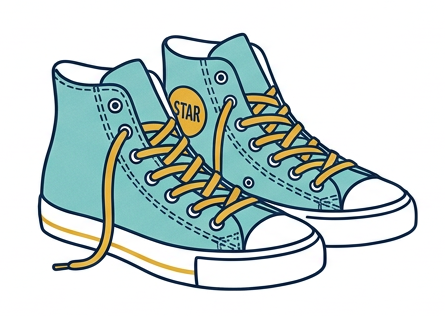
Illustration
Even if you tell an AI model to make you a pair of shoes, no no no, with flat soles, not lug soles, no, both shoes have to have the same soles, no, high tops, no - both shoes have high tops, and I want a star logo because they're chuck taylors - the AI typically will still ruin it and not understand that a star logo isn't just a circle with the word 'star'.
Benjamin Wilson frustratingly trying to get Firefly to do anything real but failing because it isn't a human, it's an AI
Experiment 1: Supplies are running out!
Let’s say that these are a pair of Converse All-Stars that you want. They’re great. They’re made out of (material that you like) in (color and texture that you find appealing) and they really just hit different. They’re the greatest pair of cons since cons became cons. The fake AI logo actually has a star and they really do make you run faster and jump higher, or at least that’s what some less factual marketing copy would say.
AND this is the last pair. I mean, probably. It’s the last one on the shelf at… eh, DSW (that’s an initialism for Discount Shoe Warehouse) and DSW has a sign that says ‘supplies are running out’. Well, supplies are running out, right? And there’s only one left? That probably means that this is the last pair. Or very nearly the last pair. Maybe it’s the last pair in vegan mushroom leather in royal purple; who knows. But if you go ask you’ll be losing the chance to buy them right now, right? So you buy the vegan mushroom leather purple high top cons. And who can blame you? Cool kicks are cool kicks.
An initialism vs. an acronym: An acronym is a series of initials that are spoken as a word. Initialisms are series of initials that are not spoken as words. GIF is an acronym. NASA is an acronym. FBI is an initialism.
Experiment 2: You should be ashamed of yourself.
Let’s say there is a pair of Converse All-Stars that you want. They’re great.
You head to DSW, and you see an ad which states that soon, you won’t be able to buy these shoes. They are in limited supply. In fact, the shoes are degrading as we speak. They’re degrading because you aren’t buying them. You haven’t bought the shoes and now they’re worthless. You are, in fact, making the vegan leather purple shoes worthless. Why are you making them worthless? Here’s a video of what happens to worthless shoes. Why are you doing this to the shoes? You’re killing the shoes. Are you a shoe killer? How does it feel to be a shoe killer? It must feel terrible. Don’t you feel shame for being such a terrible shoe killer?
That is what happens when a fear appeal in marketing is implemented to extreme. We see some organizations do this frequently, because it matches their brand or aesthetic or whatever. I don’t like the peripheral route, because someone else can come up with a stronger emotion to sway the user a different way. Fear appeals also don’t change cultures, and sometimes cultures need to change. In order to change cultures, you need people to think, rationalize, and change their deep-seated beliefs.
Why the peripheral route is risky
I’m a huge fan of the primary route. The primary route is where you present logical evidence and debate, or converse, with the other party. You present evidence, the other party presents evidence, and then each party undergoes individual social evolution. the presentation of new information allows each party to formulate new opinions.
The peripheral route is emotional. If you can find an emotion that could shortcut and jump over rationalization, then you can get find a way to convince the other party without using rationale. Scare the other party, shame the other party, or use sex to convince them. There are many emotions that can activate the peripheral route. Fear; anger; shame; happiness; joy; many things activate the peripheral route.
How to communicate climate change
This is supposed to be a case study. In a typical case study, I would talk about how there was a situation, I had a specific task, I took an action, and delivered a result. The method is called STAR: Situation, Task, Action, Result. It’s a great way to talk about a situation where I did a thing and had a direct impact. I have yet to see that happen with a single communicator. I would love to! If there’s a professional communicator out there that can show a concrete result that positively contributes to slowing or reversing climate change, I want to read your case study. I’d learn a lot from it.
I don’t think that’s possible, or it’s certainly not easy. There are a number of barriers that prevent that from happening; users have different needs than communicators see, and people in one cultural context tend to not understand other cultural contexts. But that’s what we have to do, as communicators; understand what motivates people and communicate with them effectively. I’ve certainly worked hard toward communicating hard subjects to audiences that don’t want to hear them, and I’ve known other communicators who’ve fought the same fight.
Even if it isn’t possible to do it on a large scale, some progress is better than no progress. Communicating the hard subjects - like climate change - is a big challenge. It’s an NP-hard problem; once we’ve solved the problem of how to communicate climate change, we’ll have solved a lot of how communication works. We still haven’t; it’s mostly theory, trying to figure out reality. But we’re trying. Mostly, we should be meeting people where they are and not trying to shame them into changing their behaviors.
Talk to people where they are. Don’t expect them to come to you. And respect people for their intellect; even those who haven’t graduated high school can still vote, which affects the future of our country.