Quality is a strange concept. As a data-minded person, I believe that quality is a categorical thing that refers to qualitatives or qualitative data; it is descriptive. It can be positive, negative, or simply the equivalent of metadata; data about data. Robert M. Pirsig struggled with the idea of quality for many years, however. He believed it was something metaphysical that was neither subjective nor objective, but a third type of thing that precedes rational thought. After reading Zen and the art of Motorcycle Maintenance and On Quality, I was presented with the idea that quality might not be as simple as I believe. How can something that is simple become not-simple with the presentation of additional information?
Simplicity
That’s the problem. Simplicity isn’t simple for everyone. Nothing is simple for everyone. Simplicity isn’t universal.
Simplicity is a psychological state that is highly coupled with understanding.
- Daniel Faltesek, Oregon State University
Have you ever created a thing - let’s say a design - and submitted it to your boss, who told you to ‘make it more simple’? How difficult was that to achieve? It wasn’t simple, right? I’m inclined to say that simplicity doesn’t really exist, except it exists psychologically. Simplicity is something that is very real to each of us; the problem is that it isn’t defined the same way across different people (TL;dr - want to know how to bypass simplicity and all that jazz, and just make a comms strat that works?).
Infographic
Simplicity isn't universal.
Benjamin Wilson
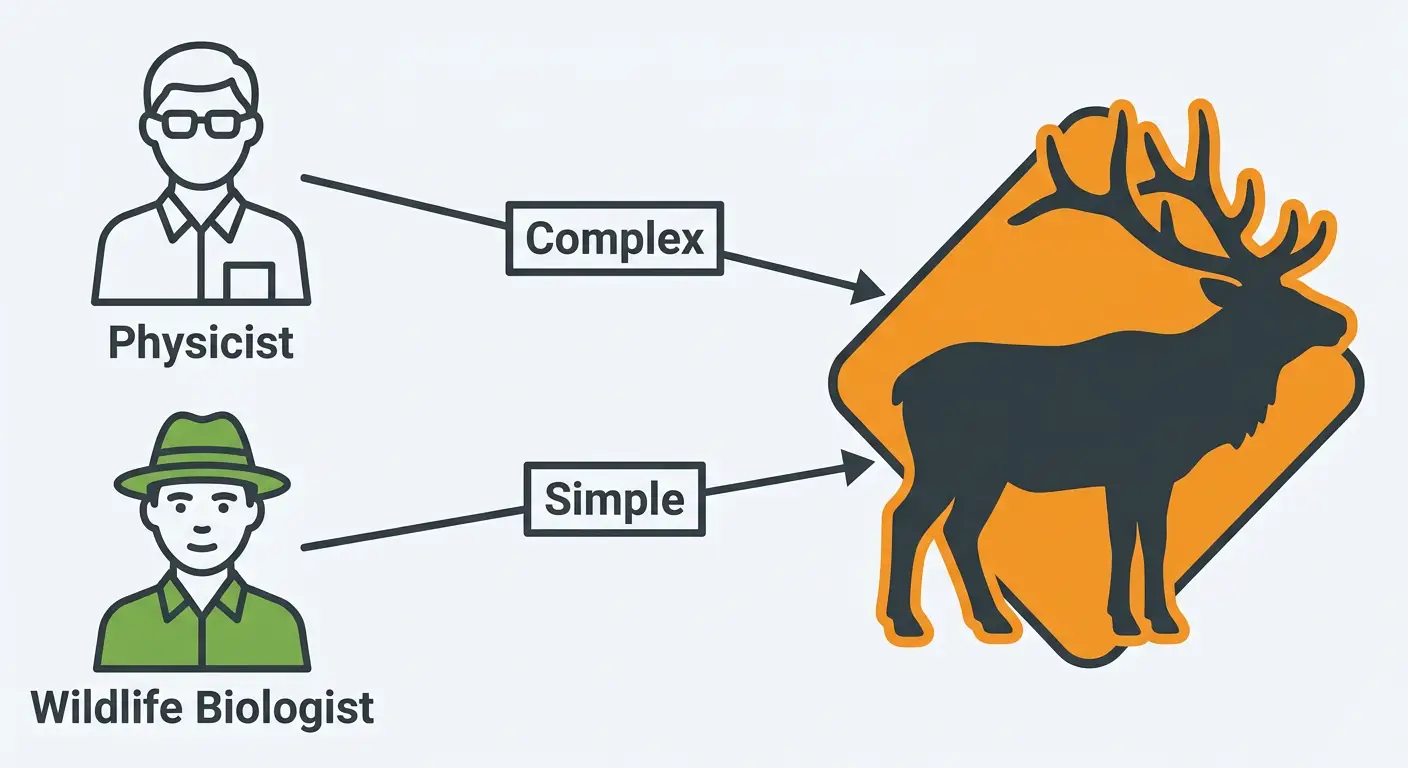
Take two individuals with two backgrounds, two different sets of experiences, and two different fields of education. If one is a Physics major and the other is a Wildlife Biology major, it is far more likely that the Physics major will understand concepts about the probability of particle positions and velocities than the Wildlife Biology major. Similarly, the Wildlife Biology major is more likely to understand the habits of Rocky Mountain Elk. To each, different things are simple, based on their psychological states and understandings, and I would say, their respective contexts and backgrounds.
Complexity
Oddly enough, complexity seems to be relatively easy to define (or it seems simple to me, at least :D ). Take a system with very few parts. A watch face is a great example. Add more things. The system becomes more complex. Apple calls them ‘complications’, which is really cool because it’s accurate and portrays a deep understanding of the concept.
I think most people would agree that adding complications to a thing increases the complexity. I wouldn’t disagree. The difficult part here is; if adding complications increases complexity, does removing complications increase simplicity? Furthermore, how much simplification is required in order to reach something that is simple? I don’t think it’s quite that easy, unfortunately. Rendering things in terms of complex and simple paints the world as a number line, simple on one side and complex on the other. I don’t think that’s how it works.
Simplicity seems like it is a privative, rather than a qualitative attribute. Privatives are things that we have concepts for, but don’t exist, like holes, or dark, or cold. There are no physical things that define cold; cold is simply the absence of heat. Dark is simply the absence of light. Is simplicity the absence of complexity?
Probably not. I think Dan Faltesek is right, here. I think simplicity is internal, and is a psychological state that occurs when your knowledge and understanding are able to accurately interpret the state of a system.
| Category | Concept | What is it? | How it is measured? | Is it universal? | Is it real? |
|---|---|---|---|---|---|
| Privative | Cold | The absence of thermodynamic energy. | A decline in thermometer readings; a loss of energy. | Mostly. Preferences for temperatures vary, but changes in temperature are mostly universally felt. | Is it real? Not exactly. |
| Positive | Heat | Thermodynamic energy. | An increase in thermometer readings, or an addition of energy. | Yes, heat is universal. | Heat is energy and is a real thing. |
| Privative | Dark | The absence of light. | Oddly enough, you can measure darkness on a ‘Sky quality meter’ which outputs magnitude per arc-second of light, which you can translate into the Bortle scale of darkness. | Yes, darkness is universal with exceptions for differently-sighted individuals. | No, darkness isn’t real, even if it is measurable. |
| Positive | Light | Photons, which exhibit wave-particle dualism. | Light meters measure in many different scales, but typically as photon impacts on a sensor, expressed in a given scale. Ask your local hydroponic shop, they’ll tell you. | Yes, light is universal. It is the speed limit of the universe. | Yes. Light is one of the most real things that exists. |
| Psychological state | Simplicity | A state where an observer’s background allows interpretation of a system. | Internal comprehension and context | No, simplicity is not universal. | Subjective. What is simple to one is opaque to another. |
| Psychological state | Complexity | The density of components in a system. | By the number of complications in a system. | No, complexity is not universal - but it is easy to mentally simulate. | Objective but not measurable: you can count components, but you can’t count cognitive load. |
There’s probably a Dunning-Kruger dimension to it, as well; when you understand more, you understand the depth of what you still do not understand, which makes things even less simple. This is what plagued Pirsig; the more he learned, the less he knew. It seems counterintuitive that additional knowledge can decrease knowledge, and it doesn’t, exactly. Adding additional knowledge on a subject creates an awareness that there is yet more to be learned about that subject, which is how learning more about something that is simple can result in what was simple becoming complex. The additional knowledge creates a different understanding, and changes your psychological state.
Understanding
Simplicity as a psychological state; that’s a really interesting thing to think. When I first started attending Oregon State University, I got into a few of Prof. Dan Faltesek’s lectures, and he had these really interesting ways to say things - things like “What is the meaning of video games?” And the idea that the anger and furor that result from social media are “Interest”, and that the word “Interesting” doesn’t mean that something is good, just that it generates interest, which is the feeling of curiosity or attention toward something. And that the word “Important” doesn’t mean positive things, necessarily. HIV is an important part of the AIDS epidemic; that doesn’t make it positive. It carries great import, great significance. In these cases, understanding the dictionary meanings (read: actual meanings) of these words makes certain concepts more simple; a logical proof that simplicity is a psychological state.
Learning about media theory, communications theory, and theories of power, responsibility, surveillance, civics - all of these things contributed greatly to my own background, eventually integrating into my own psychological state. This means that if someone wants to talk about things like panopticonism, bits of entropy, signal-noise ratios, society building, or identity performance, all of those are relatively simple for me to understand.
Here’s an example. Did you know you can use an Ulu to skin a caribou? I didn’t. I learned this in rural Alaska.
There are so many parts to the mechanics of hunting and subsistence that seem simple to someone who knows how, and knows what all of those things are. It is simple once you know, or it is simple once you’ve thought about it; we often say these things when presented with new ideas. Adding to your knowledge and understanding increases the amount of things that you might consider to be simple. But if you don’t know what an Ulu is, don’t understand the difference between a caribou and a reindeer, and don’t understand why people in rural Alaska hunt for subsistence, let alone the social facets of not living on the road system, what the road system is, and that subsistence is a large part of life for many Americans - none of these things are simple.
Universality
The complex part about simplicity is that we all possess a concept of it, and we all live within our own heads. We all tend to believe that the things we think are the same things that everyone else thinks. This is known as egocentric bias, which is one of the most poisonous traps you can fall into as a professional communicator. In the case of people not from rural Alaska not understanding the pressures of life in rural Alaska, there’s also a great deal of ethnocentrism in play, which is another deadly trap for communicators. Your experience is not my experience. My experience is not my audience’s experience.
Applying this to real life
If we can’t understand what is simple for someone else, how can we possibly hope to communicate with them?
Fortunately, the idea of universal simplicity isn’t necessary for clear communication. What we need to do as communicators is to empathize, find effective ways to communicate with the other part of the communication cycle, and to listen for what they have to say. There is a system for how to avoid the simplicity trap: just sidestep it entirely, and try to understand the other conversant.
- Avoid using insider jargon - it will exclude anyone who isn’t in your group.
- Avoid creating barriers to understanding (insults, slights, marginalizations).
- Avoid trying to adopt the slang of the group you’re trying to talk to. It will ring as non-genuine and create more noise.
- Listen for what is important to your audience.
- Listen for your audience’s needs.
- Don’t just wait for the other party to stop before you blast out another message; take the time to interpret the meaning of what was said.
The interesting thing about communication is that it is an active endeavor on both sides; you try to encode your meaning into your message, and the receiver tries to decode your meaning. They aren’t passive receivers; they actively try to understand what you mean, so you need to actively try to make a message that your audience will understand.
Does that sound simple? Probably not. It probably sounds like work. But that’s okay; nothing in life is universally simple. Just try, and others will try, and then improve your approach through learning. As long as you aren’t flinging mindless press releases and tone-deaf tweets into the void, it’ll probably end up right in the end.