I built a career intelligence system into a Claude skill; it keeps you accountable, and it doesn’t lie on your resume.
Early stage insights:
- First 72 hours: Accessed a little over 350 times
- Impressions: Initial user testing shows that it's a positive tool to work with
- License and availability: Free and open source
The problem
I’m moving from the public sector to the private sector for the first time since 2016. I just finished a degree in Digital Communication Arts, so I came to this particular job search with fresh eyes and a head full of models of how information moves from place to place.
Today’s job market looks like an information problem system:
- Noise. Social feeds are full of emotion and bad news about job searching, which adds cognitive load for job seekers and hiring managers.
- Opacity. Listings are increasingly word-salad, and hard to compare against your actual experience.
- Asymmetry. Employers automate more of hiring while job seekers hand-type resumes and guess at fit.
- Data. Third-party tools often treat job seeker data as the product, and generic AI knows nothing that isn’t on your resume.
Each part interacts with all the others, and it impacts quality for hiring and hiree; I’ve heard it described as “job seekers and hiring managers not being able to find each other”. So I made a tool.
My solution
I chose to make a Claude skill rather than an app or a web service, for reasons which I detail below.
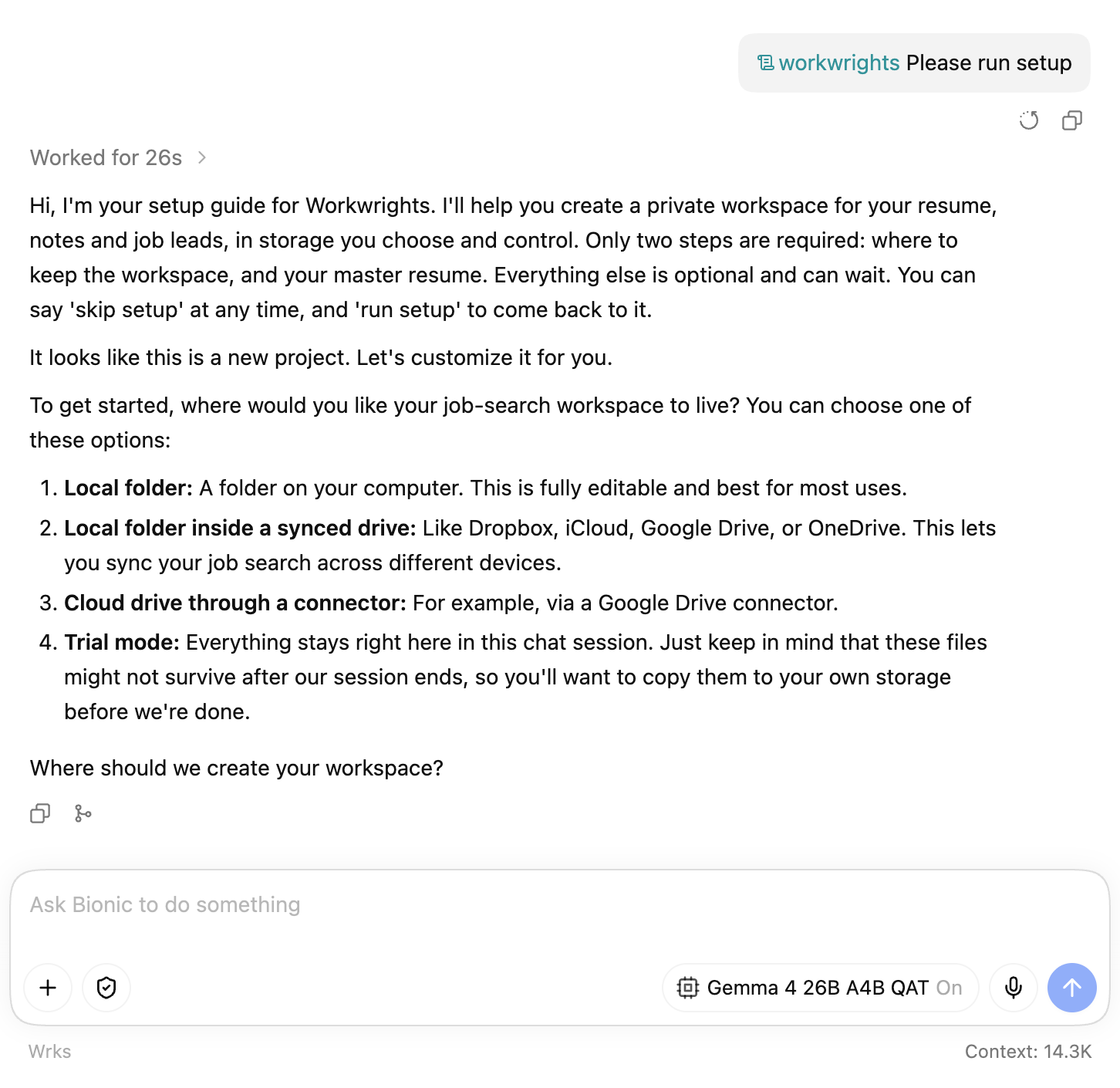
Interaction
The skill works equally well with on-device and cloud-based AI models.
Benjamin Wilson
Four design decisions
This is a user-focused product, like a lot of my strategies.
- It has to be free to use, because charging unemployed people for job tools is unethical. An app means funding hosting and development, which means charging for it. So I built a skill which anyone can run in their own AI client.
- It stores nothing. No stored user data means no hosting costs and far less regulatory complexity, which keeps it free. Workwrights doesn’t store your data internally. What your AI provider does with your conversations is governed by that provider’s own policies.
- The user owns the record. Your files, your identity, and your evidence bank live with you, and the AI reads from that master record instead of relying on an ever-growing chat. That keeps context small and gives the assistants facts to check against.
- The AI suggests, you write. Your voice, your claims, your responsibility.
The evidence bank is a record of your whole work story, with numbers. In five years at one job you may do hundreds of things, then compress them into five bullets. The bank keeps the rest, so every listing can be measured against everything you’ve done.
I’ve tested it on the free tiers of Claude and ChatGPT, and on-device AI via LM-Studio. Free plans often lack local folder access, so there’s an option to use Google Drive. It also has a light search mode built-in to keep usage low; excellent for free users.
Five assistants
It’s built around the idea of five specialist assistants;
- Scout finds, collates, and tracks job prospects. It can search the web if your AI client and plan allow it.
- Evaluator compares a listing against your evidence bank, finds gaps, and suggests ways to address them. It measures fit against your actual experience, not keywords.
- Editor learns your voice, style, and tone, and suggests how to shape resume bullets and cover letters. You write them.
- Researcher digs into reviews, controversies, and anything worth knowing before you apply.
- Ellis, a career coach, listens without judgment and gives evidence-based feedback and some coping techniques. Not a therapist; helpful nonetheless.
One test run
To see what the evidence bank adds, I ran the Evaluator twice on a posting; a director-level content and digital experience role at a cybersecurity company. I used the same posting text and the same eight criteria both times, and I scored the first run before opening the bank or my tailored resume.
| Score | |
|---|---|
| Master resume only | 64.7 |
| Tailored resume + evidence bank | 73.3 |
An 8.6-point gain by following Workwright’s edit suggestions. This isn’t dissimilar to running a prompt to evaluate your resume, making edits, then running it again - except the evidence bank informs the edits, and this runs by simple commands, rather than tracking multiple lengthy prompts. According to the Evaluator, about two-thirds came from the tailored resume and about a third from the bank. This is not a controlled result, because both inputs changed at once. This was one posting, one run each, scored by one person.
The score increase doesn’t matter as much as the rest of the cycle; It also lowered the contribution of some of my claims. It believed I had no evidence of automated GEO tracking, no line authority at one of my past employers, and no conversion or revenue results on a specific bullet point. This is interesting, because the AI cross-checks against your own data, rather than allowing for inflated claims to please the user. The centralized memory architecture keeps evaluations fairly rigorous.
What early users say
Workwrights was accessed 253 times in its first 48 hours. That’s a mix of downloads and repository clones, leaning toward clones. I don’t track how people use it, so everything below is voluntary feedback from a few early users;
“The evaluator thing is the part I actually use. Most of those ‘resume match’ tools just count keywords and give you a useless percentage.”
“It’s worth seeing the gaps and choosing which ones to chase, since some gaps aren’t worth bridging.”
“This thing actually translates bad job listings?”
Users also mentioned the light search mode, which keeps usage low, and how Scout contributes to the tracker.
What I don’t know yet
No one has landed a job with it, and it’s too early to expect that. I can’t tell you whether it works for most people, only that early feedback is encouraging.
It’s under the MIT license, and it’s available free and open-source at the Github repo, where you can read documents on how it works, download it, and roll your own if you so desire.