This is a free template for a communications strategy. You can download it , and you don’t have to sign up for anything. I’ll explain how to fill the whole thing out.
How do you make a communications strategy?
You can go large, you can go small. I prefer this chonkier format because it covers everything you’ll need in a topical list. I’ve seen a lot of comms plans without a demographic analysis (an audience section) and I highly recommend that you always perform a demographic analysis, even if you cut out some of the other stuff. At the very least, port in an older one. Shouting to an empty room will always yield lower ROI than conversing with a highly engaged audience. Plus, comms plans without considering the other side of the comms cycle are doomed to failure (evidence-based opinion), along with favoring self-centered messages and being blind to the people you’re affecting.
Communications Strategy Format
A guide to the sections of my preferred comms strategy format.
flowchart TD
    A["Summary"]
    B["Situation"]
    C["Objectives"]
    D["Audience"]
    E["Core messages"]
    F["Channel map"]
    G["Action plan"]
    H["Feedback and analytics"]
    I["Risks and contingencies"]
    J["Resources"]

    A --> B --> C --> D --> E --> F --> G --> H --> I --> J

    classDef foundation fill:#dbeafe,stroke:#2563eb,color:#1e3a8a,stroke-width:2px;
    classDef strategy fill:#ede9fe,stroke:#7c3aed,color:#4c1d95,stroke-width:2px;
    classDef execution fill:#ffedd5,stroke:#ea580c,color:#7c2d12,stroke-width:2px;
    classDef evaluation fill:#dcfce7,stroke:#16a34a,color:#14532d,stroke-width:2px;
    classDef risk fill:#fee2e2,stroke:#dc2626,color:#7f1d1d,stroke-width:2px;

    class A,B foundation;
    class C,D,E strategy;
    class F,G execution;
    class H evaluation;
    class I risk;
Summary
Write this last. An executive should be able to read an Executive Summary and make a decision, so it needs your important data points in it. My preference: 30 seconds of read time, answer who, what, and why. Aim for no more than a paragraph for the key points, three supporting bullet points, and one supporting paragraph. Tie paragraph one and your bullet points to business objectives or KPIs.
Downloadable template
If you want to cut to the chase, here's a word version. This is intentionally bare-bones and structural; you adapt it to your own branding or dress it up as much as you need.
I recommend personalization. You can always credit me to your boss if you want, but I don't require it. I'm distributing this under the CC-BY-SA 4.0 license.
Building the template into the real thing
I recommend an audience-centered, asynchronous approach to filling out your comms plan:
- Situation
- Objectives
- Feedback and analytics
- Audience
- Channel map
- Core messages
- Action plan
- Risks and contingencies
- Summary
-add any pertinent data to resources any time it shows up. You'll be revising this plan continually; I don't think I've ever seen a plan work seen a plan function beyond the first couple of planning meetings if it was intended to live as a static document. Assume it is a living document; it might even help to introduce it as a living document, so your partners expect changes. Version control is on you, though; you might want to keep a draft copy and a regularly updated copy, but you don't want a comms plan that's full of tracked changes. That feels very writerly, but it is unorganized chaos.
Situation
The situation section should contain;
-
Background
A succinct breakdown of the context and background of what you're trying to do here. This provides why you're doing what you're doing. -
Problem statement
Straightforward. I have a post on deconstructing problems, but if you need to make a problem statement;- State the core problem - don't state a solution in the problem statement.
- Substantiate it with some kind of proof, preferably a number.
- Close the problem statement with why it matters to us.
-
Opportunity
Potentially favorable conditions that could be a competitive advantage. Market research may be helpful, or social research. Depends on what you're doing. -
Risks
Kind-of the opposite of opportunities; these are potentially unfavorable conditions that could lead to a loss of competitive advantage, or harm. -
Key metrics
"You can only improve what you can measure." Buuuut, don't just SWAG this; this is a great opportunity to tie the comms plan directly to the company bottom line. The more accurate you are, the more you can point at it in the future and say "Look, we did a thing." -
Challenges
What things will make it difficult to accomplish your goals?
Objectives
I like to break this down into two sections; Goals and Objectives. Goals are broad, abstract, sometimes qualitative statements on what you hope to achieve. Objectives are more detailed, often quantitative steps to achieve that desired abstract state.
Examples:
- Goal: Increase brand loyalty and mind share in the 25-34, upper middle class demographic in the north Denver area.
- Objective: Increase followers in the area by 11-13% Y-o-Y and increase engagement rates by 1%.
Note that you don't provide a solution or road map here. This is just the objective/goal segment.
Feedback and analytics
How do you know that you're doing a good job? This is a good time to dust off your communication models. Specifically, I favor the Osgood-Schramm model for this one:
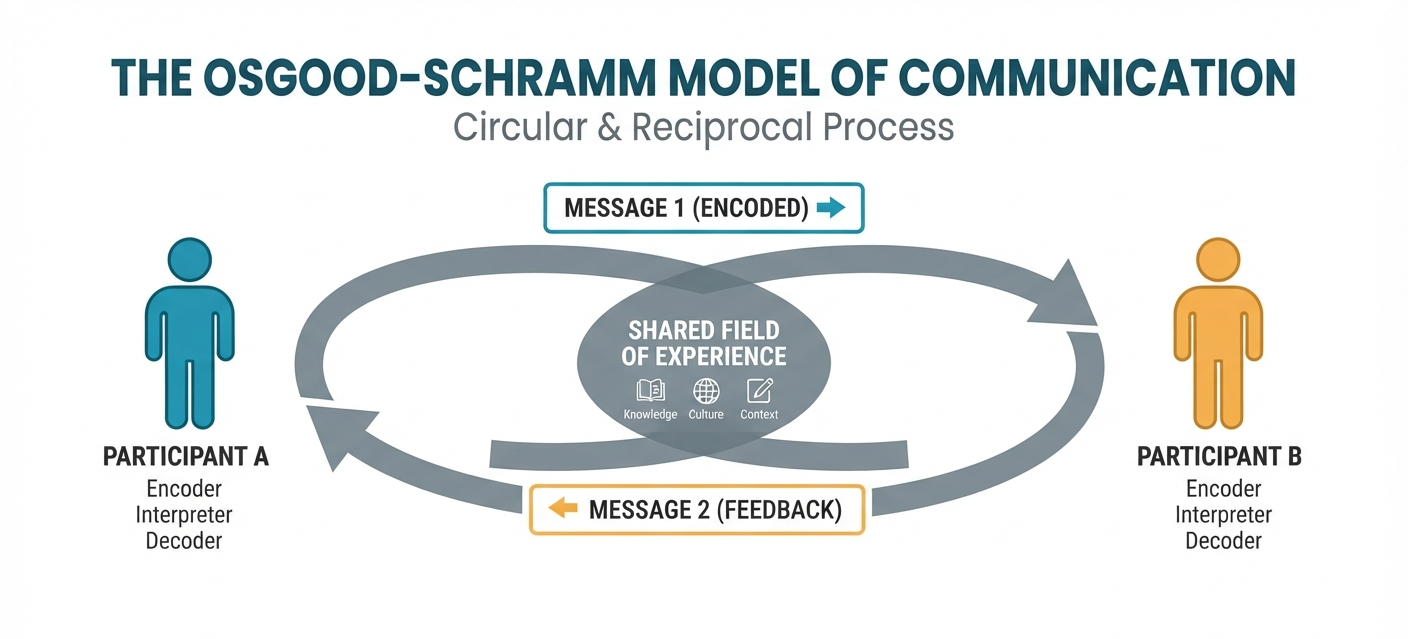
Infographic
Osgood-Schramm model
By Ben Wilson
You, Participant A, encode information to Participant B, who decodes it, then replies in a feedback loop. This tells you some things;
- If your strategy is working
- How your strategy is affecting emotions and actions
- If there are any potential risks on the road (This is called issues management)
That type of feedback provides qualitative data, which is incredibly useful but hard to count. For that, you need quantitative data - Google Analytics, Social analytics, Sentiment analysis numbers, conversions, sales, whatever. Come up with a way to collect all of that data in one place, if you don't already have one. It can be a spreadsheet, a smartsheet, a dashboard, an airtable base, Notion, Qualtrics, whatever. Just put it all in one spot so you can make pretty visualizations for your reports later.
Last but not least:
When you're looking at the entire thing later, don't forget to combine your qualitative and quantitative, and get some insights out of it. 13.1M users in a day means nothing. 13.1M users in one day, followed by 15M users the next, followed by a weekend of +$1M sales W-o-W can make an insight.
Audience
Do a proper analysis of the other humans you're talking to. Seriously. If you know who you're talking to, you can determine where they're listening and how to talk to them.
Ignoring your audience means losing 1/2 of the value of the conversation. You're putting in the effort to make a comms plan, do it right.
Channel map
Since you defined your audience, you can figure out what channels to use. Some considerations:
- Are there publicly available data which show the channels and devices your demographic favors?
- Are there political or geographic boundaries that affect which channels penetrate in their area?
- Are there any geopolitical considerations that would affect which channels to use?
- Are there any physical barriers that would affect which channels? I've worked with audiences in geographic areas that had no internet, television, or radio penetration. Not all audiences are the same or have the same access.
- Are there other audiences in the channel or area that you need to be aware of, other than your intended audience?
- Do you have segmentation capabilities to restrict delivery to only one audience?
Be aware of context and noise in your chosen channels. Context is typically cultural, sometimes microcultural; a certain acronym on Reddit may not carry the same meaning on Facebook. Noise is, well, anything that could interfere with your message being decoded accurately enough to elicit the desired action. Psychological, historic, and linguistic barriers are examples of things that can interfere.
Core messages
Put lists of talking points, key messages, and Q&A in here.
Is there a chance that anyone in your organization might be a point of contact for the press? If so, put info for press contact cards in here. If you aren't the person who educates your staff on press contact protocols, just tell that person that you have some press Q&A content for them.
Action plan
This section needs to have a plan of action and a timeline, and it's not a bad idea to put deliverables in here. It doesn't need to be a full-fledged project plan, but some general ideas are fine. Write it with room for flexibility. I favor open, editable formats for the timeline; tables, sheets, smart art, whatever.
Risks and contingencies
Put on your red team hat, and think of what could cause your strategy to break down. Then, come up with ways to prevent those events from occurring.
Pro Tip: Want to be fancy? Assign a three color scale to each risk:
- Green for low risk, things that are unlikely to stop the strategy
- Amber for medium risk, things that can stop the strategy but not harm the business
- Red for high risk, things that can harm the business
If you're mapping your risks in a spreadsheet or a table, it's usually pretty easy to set conditional formatting. You can also use a block character like █ and change the text color. You can sacrifice amber and go for eye-gouging yellow if you just use highligher á la Word.
Summary
There are a number of formats for writing summaries. You want to write a shorter, punchier summary for an executive, and a longer, detailed summary for an operational audience. I like this format:
- Introductory paragraph: No more than 20-30 seconds of read time. Aim for 100 words, with the key points.
- Up to 3 bullets: Pick the 2-3 biggest supporting points of data.
- Supporting paragraphs: I try to limit to 1-2. Projected benefits and timeline are good options here; if you need a 3rd, you could summarize your strategy and goals, then do benefits, then do timeline.
Sometimes an executive summary can be as long as a page; you know your audience best. Respect their time, though; if you catch someone in a hallway or between Teams meetings, they should have all the info they need to make a decision in about 30 seconds. Elevator pitch, not master's thesis.
Want the template?
Here is the template in .docx format. I recommend personalization. You can always credit me to your boss if you want, but I don't require it. I'm distributing this under the CC-BY-SA 4.0 license. Have fun, enjoy the challenge, and make the world a better place.