Who is your audience and where do they listen?
We’re going to walk through a practice round of how to identify your audience demographic and where your audience is having their social conversations and consuming media. These are two of the steps in my comms strategy template which I highly recommend to any strategic communicator (I recommend taking these steps, and I also recommend my strategy, but feel free and roll your own), and I’ll provide resources, links, and we’ll build a listening profile as we go along.
If this seems like too much work for a simple ‘ol comms strategy, I disagree; your communications strategy is the core of many actions, and having the best understanding of your users is useful for communications, marketing, and business in general.
The case study
For this particular case study, our brand is called Brass Rule watches.
The brand
They’re a fashion brand that focuses on medium-upscale, handcrafted watches with Swiss movement, focusing on reclaimed and sustainable materials. They have several watches in the $1,000-$1,500 price range. Let’s put some jank AI imagery in here (created by Adobe Firefly, so they aren’t plagiarized, just low-effort) to simulate some of these products, because I can’t be bothered to become a master watchmaker in order to make a case study.

Fake photo
Two watches.
Benjamin Wilson
There you have it, Brass Rule watches. We have two nice watches here: one for large wrists and one for small wrists. Brass Rule doesn’t gender their watches, so they don’t use ‘men’ and ‘women’; they also feel that this will be a good move for future expansion into APAC regions, where wrists tend to be smaller than they are in North America and Europe. Right now, Brass Rule distributes online and in-person, but their online model is store fullfillment out of their Akron, Ohio, brick-and-mortar storefront, where they also handcraft their timepieces out of mushroom leather and marine brass, fitting in the precise Swiss movement.
Brass Rule likes to handle returns in-person, because they fancy themselves as an artisanal business. They don’t want an impersonal experience; they want returns to be a conversation, so they can help people find the right artisanal timepiece that they’ll love and give to their grandchildren (or nieces and nephews if they don’t have grandchildren). This naturally limits the distribution radius; people can shop further out, but the in-person nature of returns will have a chilling effect on far-flung purchases, even if it doesn’t impact local purchases.
The audience
Hopefully, Brass Rule knows their audience demographics fairly well, because they’re slinging watches at ten to fifteen bills a pop. We don’t know who their audience is, though, so we’ll have to do a little digging.
Watches are a high touch, tactile shopping experience, and e-com returns average 24.5%, which reinforces the geographic limitations of their shopping. We’re probably looking at a geographic range of about 20 minutes. They may have the occasional purchase in Canton, but they won’t see a lot from Cleveland. Pittsburgh and Columbus are right out.
Why does this matter? The context establishes the geographic bounds for our demographics, and the product pricing stratifies it a little further. If we look at our geographic area, we can start to make a couple of profiles. Here’s our blank table that we can start filling in;
| Group name | Age range | Income | Purchasing factors | Area |
|---|---|---|---|---|
We’re looking at an entry-level luxury watch which maps well onto a real-world watch like a Zodiac or the occasional Omega. These are typically a purchase of around 1% of the annual salary for an aspirational buyer, or a knockaround watch for a casual buyer. Hobbyists - horologists - might also prize them for their craftsmanship, but would have a lower general income than either of the first two. So we have $1k x 100 for our core demographic, $1k x 150 for our casual demographic, and maybe $1k x 75 for our horologist demographic - they’re probably looking at Klarna or Affirm to afford entry-level luxury timepieces. Let’s put that data in;
| Group name | Age range | Income | Purchasing factors | Area |
|---|---|---|---|---|
| Aspirational | $75k-$150k | Affordable luxury. | ||
| Casual | $150k-$250k | Something to wear to tennis. | ||
| Horologist | $50k-$75k | Appreciates the craftsmanship. |
Now we’re getting somewhere. Let’s do a little research on who makes that kind of money near Akron.
Married families in Akron are earning right around our Aspirational group’s sweet spot, but non-families really aren’t. This means we’re looking at a much tighter geographic area for where our groups are located. The horologist group is probably good, though.
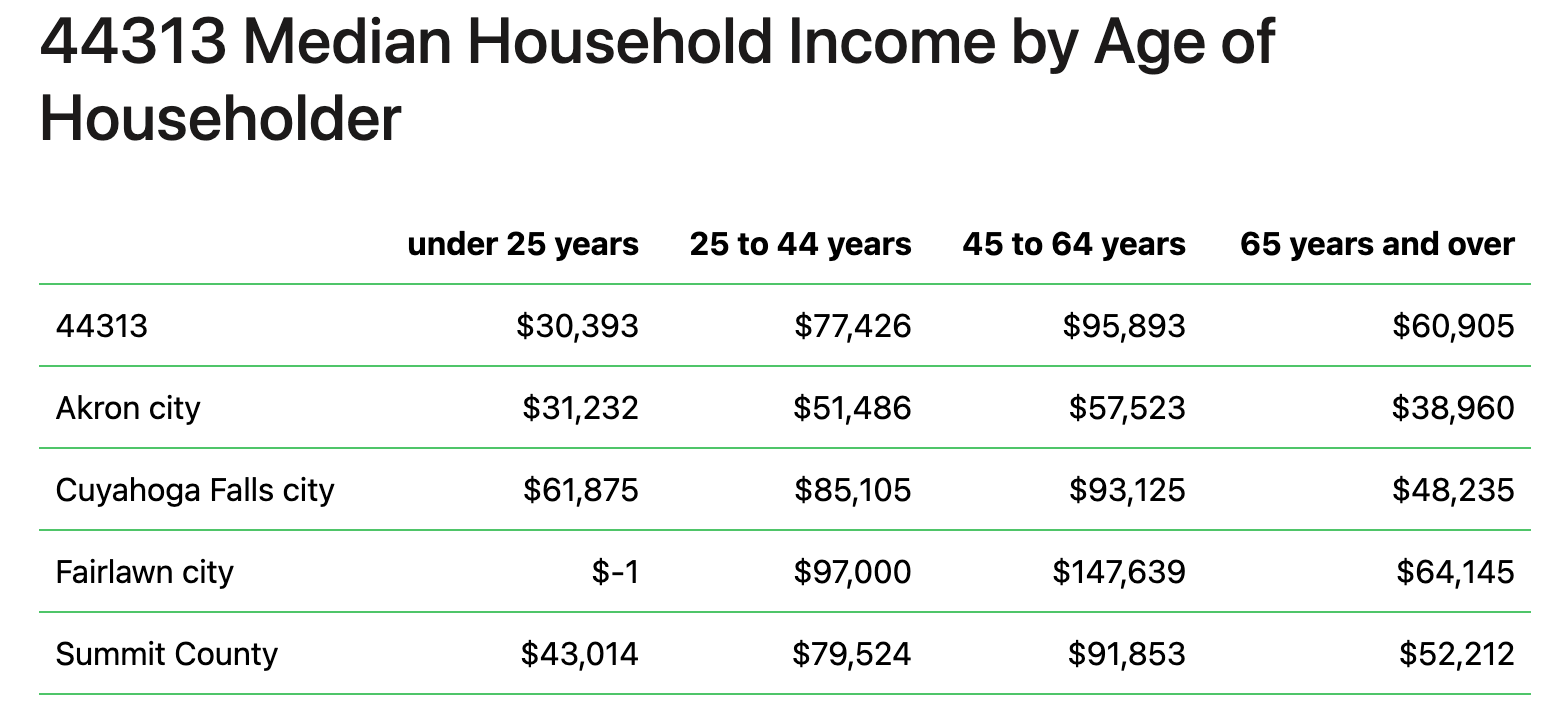
44313 Income by age group
incomebyzipcode.com
Breaking it down by area, the 44313 zip code has a pretty decent income and it looks like we’re hitting the aspirational range in the 30-45 segment or thereabouts, although the 45-64 segment has the highest median income in Akron in general. This probably gives us a second aspirational group.
Casual buyers aren’t as common in Akron (or in most places), but Fairlawn has a median income in the 45-64 age range of $147,639, so that means there are people making above the median. We could dig deeper; if you’re doing this for work, I recommend digging deeper.
Hobbyists seem pretty likely to be in the 25-64 group in Akron city, with a median income of between $51k and $57k, or elsewhere. These won’t be the most common buyers, but they’ll make up a percentage.
Let’s take all that and fill in the table.
| Group name | Age range | Income | Purchasing factors | Area |
|---|---|---|---|---|
| Aspirational A | 30-45 | $75k-$150k | Affordable luxury. | NW Akron, Fairlawn |
| Aspirational B | 45-64 | $75k-$150k | Hands-on experience, tactility. | NW Akron, Fairlawn |
| Casual | 45-64 | $150k-$250k | Something to wear to tennis. | Fairlawn |
| Horologist | 25-64 | $50k-$75k | Appreciates the craftsmanship. | Akron City |
This is a pretty good start. Even I’d call this a good start, and I love to overdo things.
Where are they listening?
You can very easily be tempted to generalize age ranges to social media platforms, and that’s honestly not a bad way to go. That’s burned me before, so let’s take a look at the electromagnetic spectrum and the mass media outlets that are available, because we want to know about internet penetration, mobile access, and which mass media we can blast out with. Know which tools are in your toolbox. That’s actually a really good quote;
Know which tools are in your toolbox. -Ben Wilson
Why is this important? Are you going to use SMS? Geofencing? Do you want to keep in touch with people via text? Are you hyper-segmenting? Lots of reasons to know what media you can and cannot use. Don’t be like that one orange big box store chain and force geofencing while inside of a giant steel structure that acts as a Farraday cage and attenuates signal, so the geofencing is essentially useless; know where the dead zones are.
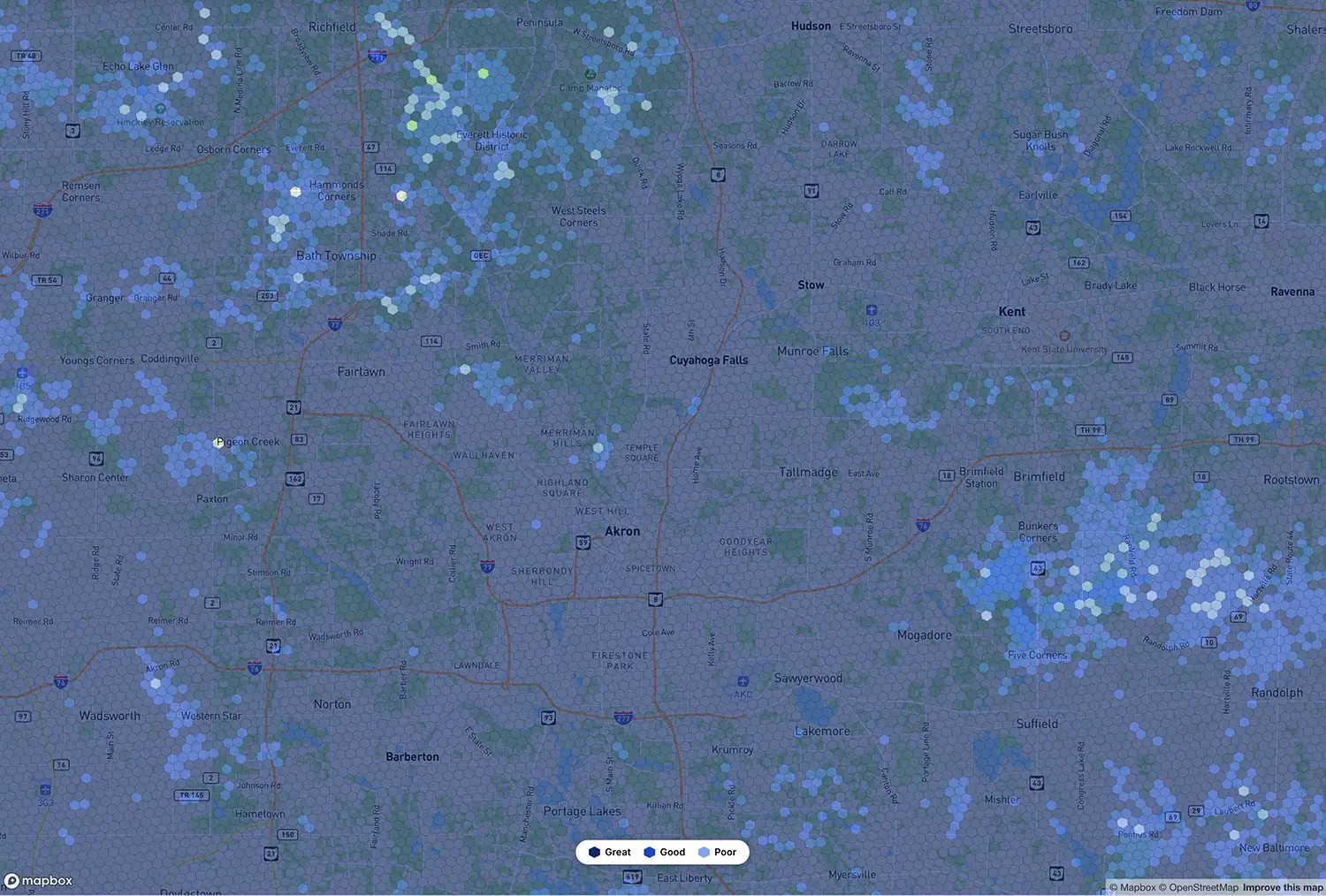
Coverage map of Akron and environs
coveragemap.com
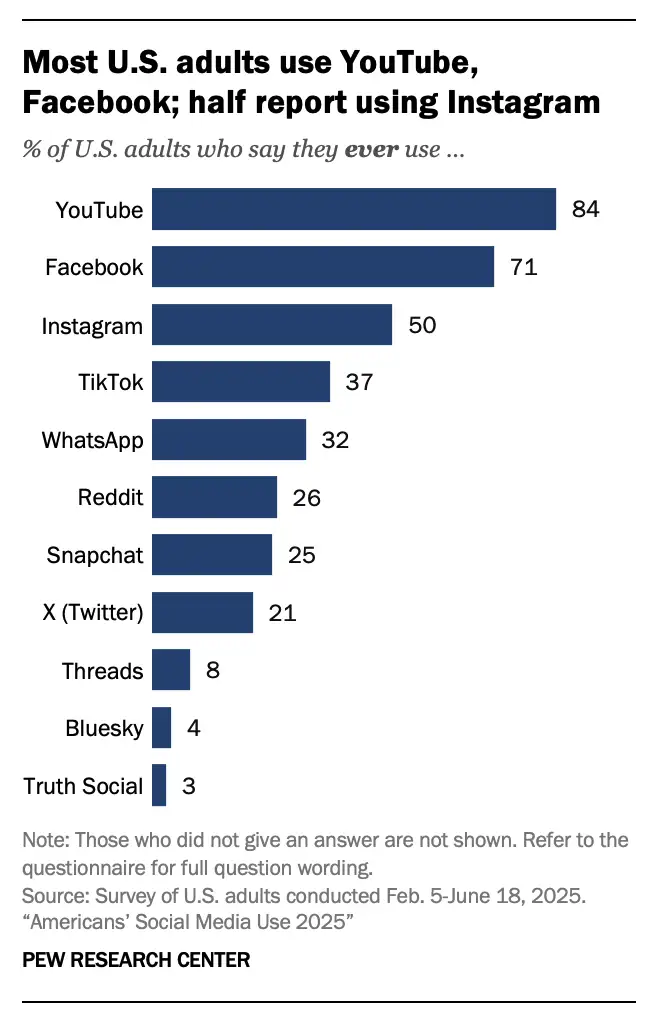
Social media usage by platform
Pew Research Center
Akron has, predictably, pretty good coverage, but there are some nearly-dead pockets near Fairlawn, where the majority of our target demographics live. Looking at the overlay, those are highly wooded areas, which might also map to larger properties or properties that have more space between them, i.e., valuable residential real estate. Takeaway: don’t rely on SMS, but it’s probably a solid tool.
This is a good time to start our second table: channels. I’m omitting most of the sources for this one, but you can dig them up. There are so many. Here’s a solid set of steps you can take;
- Look at Hootsuite’s trends report
- Look at reddit and wikipedia pages
- Look at your own platform-native statistics
- Check distribution maps and coverage maps
- Check Pew Research Center data
- Ask Gemini or Claude for sources that correlate your audience with channels
I’m going to very, very briefly dive into the last one; the Pew Social Media Fact Sheet. A few years back, YouTube began to overtake Facebook as the primary platform for U.S. Adults. Right now, 84% of U.S. Adults say they use YouTube, compared to 71% for FB. Insta is at 50%. The data also show which age groups use which platforms. Although we can’t say that this is the exact mapping of demographics to channels for Brass Rule’s audiences, specifically, this is a very, very good, empirical dataset.
Let’s plot that all out in a table;
| Channel | Type | Demographic | Strengths | Feedback |
|---|---|---|---|---|
| Akron Beacon Journal | Newspaper | Aspirational B | 4-time Pulitzer-winning. Strong journalism. | Low |
| Signal Akron | Online news | Aspirational A | Non-profit digital news. Younger urban skew. | Medium |
| The Reporter | Newspaper | African-American community | Strong community ties | Low-Medium |
| WKSU | Radio - NPR | Aspirational A, B, Casual, Horologist | NPR affiliation, and targets our demos specifically | Low |
| WONE | Radio - Classic rock | Aspirational B, Casual, Horologist | Targets Gen X. | Low |
| Social Media | Aspirational A, B, Casual, Horologist | Business-focused, would work well for upwardly mobile professionals, also a utility for the 45-60 crowd | High | |
| Social Media | Aspirational A, Casual, Horologist (30-45 age ranges) | Visual discovery; show nice watches. This is an influence channel, with some buy potential. | High | |
| Social Media | Aspirational A, Casual, Horologist (30-45 age ranges) | r/akron and r/Watches are gold for this, but avoid shills. They are a huge risk. | Highest | |
| YouTube | Social Media | Aspirational A, B, Casual, Horologist | UGC and influencers have a lot of weight with all of our demos. | High |
| Social Media | Aspirational B, Casual | Daily destination for these demos. They track marketplace, watch local businesses, and follow community pages. | High |
We’ve established our demographics and their channels; now, you can make media connections, formulate some witty Insta captions, and contact some creators. Everything’s great, except for that whole problem with in-person-return friction. That’s going to rub our Aspirational A group the wrong way; they really like e-com.
The elephant in the room
This is probably one of those times when, as a communications manager, strategist, director, or whatever your title is - you might want to talk to your client/boss. Your research shows that they’re probably leaving a lot of money on the table with that in-person-only policy. If you saw conversations on Reddit about it, those are good material to bring with you; show actual, qualitative examples of user dissatisfaction or distrust.
That’s called issues management, and it’s an incredibly important skill to have. If you see something brewing, don’t let it blindside the boss; bring it up. Maybe you won’t be able to tie the increase in revenue to your communications strategy, because it was the result of an in-person meeting, or maybe you’re very clever and you can show that via incremental attribution (that’s a marketing tactic; the non-marketing side of comms rarely uses it). Either way, if you can make your employer more money, they should be happier.
At the very least, they’ll be unhappy, with full pockets, and a really good demographic analysis.