I’m a huge fan of overdoing things, but you really have to know when it’s okay to go over the top. Sometimes you need a little extra. Most of the time, you need to know how to achieve the right balance of inputs and outputs.
I was on a project where I was working under someone else’s communications strategy. Now, this is always a point of tension - if you’re the person with the comms strategy, you know that everyone else who creates strategies will have small criticisms, and if you’re not the originator, you’ll have lots of small criticisms. Mostly we professionals just get along all hunky-dory and don’t cause tension, of course. Sometimes, though…

Stock photo
I prefer Roget's or Merriam Webster's, myself.
Benjamin Wilson
Nouns and verbs
This particular project involved getting rid of six old paper forms and replacing them with one new, shiny, web-based form. Since I generally dislike forms, I found the logic behind the project to be impeccable. Let us reduce the amount of forms in the world, says I. Nunquam ponenda est pluralitas sine necessitate, says William of Ockham. Although simplicity isn’t a universal thing - it is highly tied to individual psychological states, and what is simple for one person will not be simple for another - in general, reducing things that increase complexity will cause an increase in simplicity. This is an interesting paradox; if you can’t define simplicity, how can you increase it? I don’t know. I’ll explore that some other time I explore that in my post about simplicity.
All that being said, the project required a lot of communication. Lots of people used these forms, so it makes sense that there would need to be a strategic plan to get lots of people who currently use lots of old forms to become lots of people who use new, streamlined forms.
How you would have done it
Here’s how I would have made this strategy - probably how you would have, too;
- Formulate a problem statement (old forms, cause lots of old form problems)
- Figure out what we’re going to do about it (shiny new form, fix old problems)
- Figure out who it affects and do a demographic analysis
- Figure out the best way to tell them that things, they are a’changin
- Come up with core messages
- Push core messages on multiple channels (website and social media)
- Deploy.
For bonus material, I would set up a two-step strategy where you push out an initial round of messages, saying “Hey, these old things are going away, try this new thing!”, and run that for about two to four months before deleting any mention of the old ones. And for bonus bonus, set up a UTM scheme that would allow you to discriminate between clicks going to the new form and the old form, and set that up as part of my feedback step. You can measure it, so you can prove it.
How it was done
Uh, so instead, the three people in charge of this particular comms strategy held a series of about a dozen meetings arguing over nouns and verbs.
No, really. It sounds like hyperbole, but the actual, real-deal-holyfield, honest truth is that the meetings involved two waves;
- They who were in charge of the project argued over when the noun form on the page - file an application, for example - could be changed to the verb form - apply.
- They who were in charge then set up meetings to argue with other people about verb and noun forms.
- Number of meetings about communications products: 0
- Number of meetings about key messages: 0
- Number of meetings about the company bottom line: 0
- Number of meetings about the users: 0
🤔
At no point were users mentioned, at no point were channels mentioned, and there were no success metrics involved. This doesn’t fit my definition of a comms plan. Any communications plan which doesn’t think user-first is inherently selfish, and won’t ever reach maximum efficiency, because you can’t iterate; there’s no feedback to base iterations off of. As a guest on the project, it was difficult to not jump in and say “You’re doing it all wrong,” but one must have manners.
The impact of the project was generally a lot of redoing things after the fact, a lot of missed communication, and I’d bet a lot of angry users.
Diminishing returns and getting lost in the details
It’s easy to point out a trainwreck of a project like that and say “obviously, everything about that was wrong”, which is what makes it perfect for a rhetorical device. It actually happened, though.
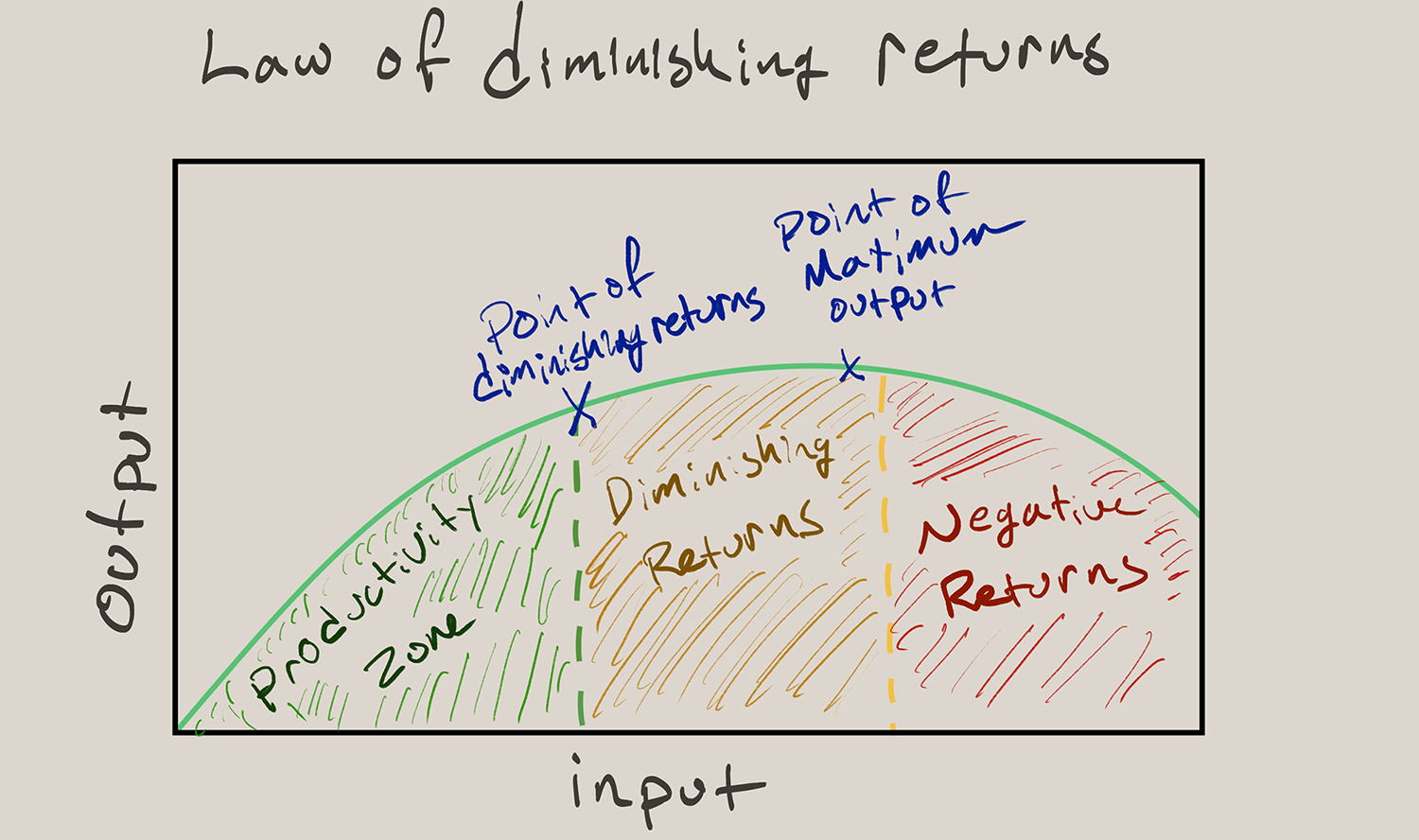
Sketched graph
The law of diminishing returns in a beautiful sketch
Benjamin Wilson
The hidden fault of that method is getting lost in details. Writing-focused communicators are famous for getting lost in the details, justifying their actions with phrases like “words matter”, which is correct in essence if not in application. When you get lost in the details, you end up spending a lot of cycles trying to accomplish very little.
The law of diminishing returns isn’t actually a law, it’s more of a principle. The idea is that, up until a certain point, your inputs and outputs are nearly at a 1:1 ratio, which means that you’re very efficient. If you design your strategy in such a way that you stop when you reach the apex of this portion of the curve, you achieve maximum productivity. This is where you should aim for in about 80% of situations. Sometimes, though, the thing you’re trying to accomplish needs a little extra. That’s when it’s totally okay to go over the top.
If you keep going, you’ll experience diminishing returns - less return on investment. Your total return will keep increasing until a certain point, though, and for a small percentage of the time, you need that extra output. Prestige projects are like that; you just need a really good return. Portfolio projects, too.
If you keep putting in effort, though, you’ll experience negative returns on investment. Putting in more effort - scheduling more meetings about nouns and verbs - won’t get a better product, it’ll yield a worse product. If you keep putting in more effort, you’ll often lose staff and receive the benefits of disciplinary action. I generally don’t recommend.
Perfection is inherently selfish
I’m a perfectionist by nature. I like spending time to create increasingly finer products, often at the cost of my own productivity. People like me often put in far too much effort for far too little product. In the end, though, you do it because it really, really feeds your pride.
You don’t focus on perfection because it helps the other side of the conversation; the user. It doesn’t. From a user-focused perspective, perfection is the moment when you have a solution that meets their needs. This is a fixed point that can be achieved, not a curve of increasingly perfect products.
That’s why perfection is inherently selfish; it doesn’t focus on whether the user has their need met. Any communications campaign which strives to achieve perfection, rather than meeting a need, is always going to end up in the negative returns side of my hand-drawn figure.
Perfection is Zeno’s paradox (not the literal paradoxes which deal with infinitely dividing space into smaller spaces, but the metaphorical one which deals with a concept that you can approach but never reach); you can approach it, and you can keep approaching it, but you can never achieve it. You’ll always end up in diminishing returns territory.
Caring about the other side of the communication cycle - the user - means that you have an honestly achievable goal. It may be a big goal, but you can achieve it.
And if that isn’t enough to satisfy you, at least you won’t end up in a dozen meetings about nouns and verbs.