When I’m presented with a new idea, I experience a rush similar to caffeine. There’s a sudden surge of mental focus and clarity, I feel more energy, and I realize how things fit together. I can think more efficiently, and it feels fun! In my case, I have a high Need for Cognition (NFC), which is a psychological trait that requires new ideas and complex tasks. This is a surprisingly well-documented phenomenon for how little it gets talked about; pop culture wants to yammer on about dopamine (despite not understanding dopaminergic systems, effects, and mechanisms), but no one talks about how exposure to new ideas - and the anticipation of connecting them - really drives primate brains, and not just mine; the thirst for knowledge drives you, too.
Idea: Exposure to new ideas can create permanent behavioral change.
The Sims and lightbulb moments

Screenshot
Even Sims experience epistemic sparks.
Benjamin Wilson
Have you ever played The Sims? It’s something of a pop-culture phenomenon over the last 20 years, where you play simulated humans going about their gamified lives. In certain cases, Sims may have traits which require them to learn new things constantly (a gamified Need for Cognition), and in other cases, when learning quickly they may experience lightbulb moments, literally a lightbulb appearing over their heads.
Lightbulb moments
Lightbulb moments are a real thing, though; humans experience them, not just Sims. Jung-Beeman, et al., wrote a 2004 paper on how humans experience a burst of high-frequency gamma band waves and parasympathetic nervous system activation when they experience insights. It’s fascinating, and it subjectively feels an awful lot like a dose of caffeine.
Light bulb moments have a lot of names; Aha! moments, Eureka moments, and so on. Sir Terry Pratchett referred to them as particles of inspiration, which is a really neat idea - except for the existence of the Dell Inspiron, the business-class laptop that is singlehandedly responsible for more idea deaths than all other technical devices combined (citation needed), which was named after ‘the smallest particle of inspiration’, those things it routinely and heartlessly murdered. Laptops aside, actual physiological events occur in your brain when presented with new information: reward mechanisms, increased brain activity, and increased efficiency. Your brain becomes more efficient with more ideas.
If only there were some way we could use these brain mechanisms to communicate effectively.
Permanent and temporary changes (The Elaboration Likelihood Model)
One of the fascinating things about the Elaboration Likelihood Model is that central route processing - the act of thinking about ideas rationally and considering evidence - leads to permanent change. Peripheral route processing - when decisions are made emotionally and intuitively - leads to temporary change. This is one reason why I prefer to avoid emotional appeals in communication; they don’t lead to permanent change.
The biggest caveat is that you can’t force someone onto the central route. You can strongly persuade someone onto the peripheral route, which is why the mechanism behind messages like “Act now! Supplies are running out!” works well; for many people, this will spur them to action. If you don’t need to effect a permanent change of behavior, and you only need to sell one product, the peripheral route works well.
| Central Route (Active Processing) | Peripheral Route (Passive Processing) |
|---|---|
| Requires thought & elaboration | Driven by emotional triggers & heuristics |
| Requires motivation & capability | Faster to accept, but temporary |
| Drives enduring, permanent change | Driven by urgency (“Act now!”) |
| Ideal for change management & behavior | Ideal for short-term sales or grabbing attention |
| Creates ownership and buy-in | …yeah, nope. |
As a mechanism, I prefer the Central route. This is also a documented trait of people with a high NFC: we prefer to think and elaborate, rather than to intuitively accept provided conclusions.
The cost of the central route, as a communicator, is that I have to provide motivation and either tap into a pre-existing capability in my audience to elaborate on the idea, or I need to provide that capability. I’ve identified three ways you can get someone onto central route processing, although this is by no means every way.
- Procedural rhetoric
- Pedagogical inquiry
- Gamification
The three mechanisms
Procedural rhetoric
Ian Bogost, a writer, designer, professor, and video game scholar, came up with the theory of procedural rhetoric. Bogost defines procedural rhetoric as “the art of persuasion through representation and interaction; more specifically, the rhetoric of computational processes” in his 2007 book. To break that down, procedural rhetoric is using interaction and thinking - often in things like games - to educate and persuade. Persuasive games, the game studio that Bogost is a co-founder of, has a ton of interesting examples of their eponymously named persuasive games, if you want to explore the concept of procedural rhetoric yourself.
How does procedural rhetoric work?
Screenshot
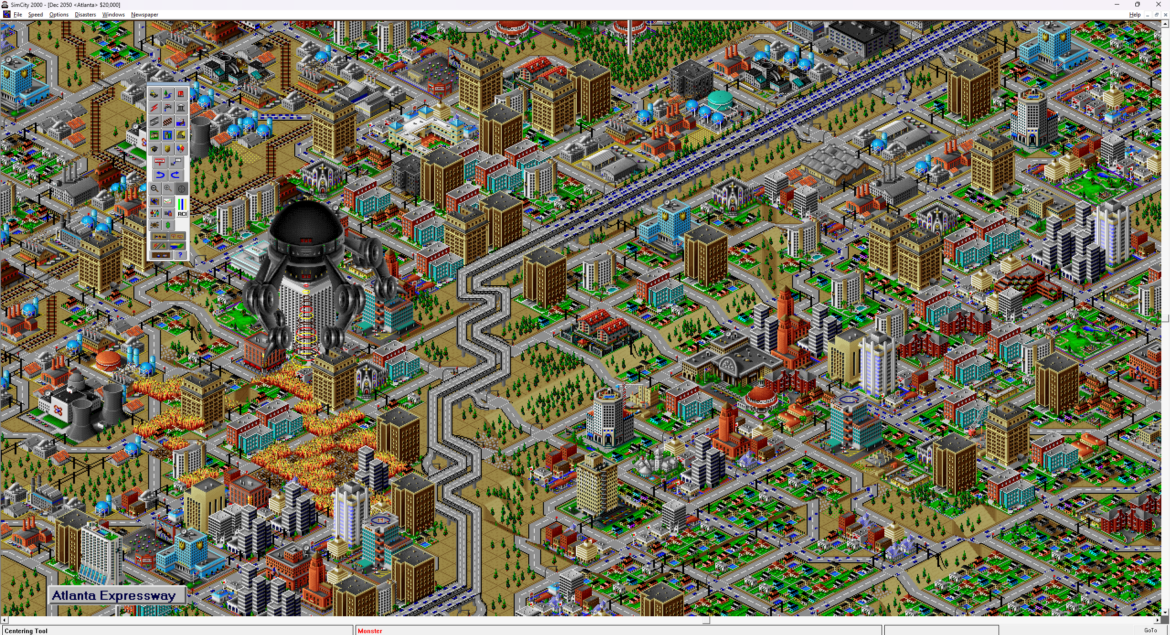
Sim City.
Let’s take a game that isn’t specifically designed to teach, and simply shares certain kinds of biases; Sim City.
Sim City is a city planning simulation game that allows you to interact with a designed city system. You lay down roads, place utilities, and put in zoning. People then move into the zoned areas, build houses and businesses, and create a functioning city under your guidance. It’s fascinating, because it contains several biases that it teaches you as you play the game;
- Authoritarianism - The player is the mayor, who, in contravention to reality, holds the absolute power over all that happens in the city. No private landowners.
- False dilemmas - Need to reduce crime? Build a police station to arrest criminals. No options to build youth centers, increase education in civics, or increase treatment of ex-cons in order to reduce recidivism.
- Nonconservation - Success in the game is tied to continual expansion. If an urban center reaches a stable limit it will degenerate. No open spaces here.
- Neoliberalism and 1980s supply-side economic theory - Lowering taxes increases economic health and increases jobs! Increasing taxes to supply social programs kills the economy. The business owners drive the economy, not anyone else. Sorry, healthy middle class, you don’t matter here.
By playing the game, you drive your own learning of these ideas; you are motivated by the game mechanics themselves, and the capability is provided to you in the form of game resources. The game system - its restrictions and methods - teach you about the thing that you’re playing or simulating. Sim City is procedural rhetoric in action, because the rules of the game - the system - teach you about the things within the game. Monopoly is another interesting example; when one player buys up all available properties and outlets, they can set prices arbitrarily and starve the economy through pure power of the supply chain.
Using procedural rhetoric in communication
I believe that procedural rhetoric is best used in smaller groups or smaller interactions. I have, however, used the same idea on social media, and I’ve seen it used elsewhere.
Example: Let’s say you need to teach a group of 12 people at work how to do something, and you have a scheduled 2-hour time slot where everyone will be in the same meeting room. You could build a type of board game and get people to teach themselves the ideas by playing the game. You could also use a more universal, pre-established game, like Jeopardy! or similar. Some group activities are designed this way, although that may be more in the realm of pedagogical inquiry, which we’ll get to.
On social media, you can deploy games - facebook games, buzzfeed-style quizzes, things like that. You can also run small events like giveaways which create both a physical and mental reward. Community affairs events are great opportunities for gamified interactions, which can use procedural rhetoric to teach; think state fairs, trade shows, and the like.
Pedagogical inquiry
Pedagogical inquiry is a mainstay of formal education, especially the post-secondary education system. In John Dewey’s classic 1910 book How We Think, Dewey first presented the idea that students learn best when they actively investigate concepts, rather than simply receiving them via lecture and reading.
Pedagogical inquiry shifts the communication dynamic from a one of ‘Lecture and listen’, where you present conclusions, to one where you present methods, facts, ideas, and intentional gaps, inviting your audience to investigate and discover the answers.
Pedagogical inquiry in communication
The mechanism of action: Dewey investigated how pedagogical inquiry and active learning work over 110 years ago, but it’s similar to any other central route method; human learns, human gets epistemic spark, human feels satisfied. Dopaminergic mechanisms create a pattern that the human is likely to repeat; this learning has led to a permanent change of behaviors.
As to whether a game played out in a class uses procedural rhetoric or pedagogical inquiry; it depends on how the game is set up. I think a game like Jeopardy or trivia which uses recall rather than investigation would be more about gamification, but it would probably also use some mechanisms of procedural rhetoric. If the game allows your participants to research the answers - like a hybrid of jeopardy that allows research - then it would likely use techniques of pedagogical inquiry.
For the record, I don’t think it matters which mechanism you use; the methods and effects will be similar.
Gamification
Gamification is an interesting idea that’s been popular for a couple of decades now. I use it in designs when I’m making some sort of interactive project, and you can use it in comms products if you do it right. The idea behind gamification is to use game-like mechanisms in non-game interactions to provide systems of rewards and motivations. A common use of gamification is in onboarding flows; provide the user with things like little badges and pings to reward them for small behaviors. The lowly progress bar that shows how far you’ve come in a survey is a gamification mechanic. Adding in vehicles to Google Maps is a gamification mechanic.
In gamified designs, you need to give users autonomy, a sense of mastery, and a sense of connection.
- Autonomy: users need to be able to make choices, otherwise it wouldn’t feel game-like.
- Mastery: users need to know that they’re mastering a concept. Skill badges are a great example.
- Connection: users need to know that what they’re doing connects to something greater, like small badges that ultimately connect to a larger certification.
These concepts mostly come from Self-Determination Theory, a framework which moves the idea of personal motivation away from a simple number line of motivation idea into a discussion of the type of motivation that drives behavior. Autonomy, competence (mastery, in my writing), and relatedness (connection, in my writing) are the three basic psychological needs in SDT. SDT is a macro-theory - a system of theories - and provides mechanisms on how to move from extrinsic motivations (carrot and stick) to intrinsic motivations.
Gamification in communication
Gamification may not be the best way to put together a press release, but you can put together a series of Insta posts that use gamification dynamics. Hootsuite, when releasing their 2026 Social Media Trends 2026 report, use a series of progressively less blurred images that you could swipe through to reveal the cover of the report. It was a fascinatingly rewarding dynamic, and they use innate human curiosity to drive their users to reveal the final, non-blurred report. It provided real-world feedback; mastery, or competence, which links back to SDT. When you completed the series of swipes, you got to see the cover of the Social Media Trends report, a reward mechanic for your mastery. Also, a really, really good report.
For those of you in the e-commerce and marketing sides of things, another great example is Salesforce training! Trailhead is a lovely, gamified system that allows you to make progress toward learning the material that is required for certifications through the use of badges, trails, and points. While you earn real-world certifications you also experience physiological reward mechanisms.
Many UX heuristics are also well adapted to gamification; if you’re making digital designs, you’d be wise to pay attention to UX heuristics. And if you’ve never heard of them, I recommend reading up on Nielsen’s heuristics; they have implications in designing simple pieces of copy, but are especially well built to inform interactive designs.
Synthesis: The Duolingo ecosystem
But, you say, what if I wanted to create a system that uses peripheral route triggers to cause a momentary action and drive people toward the central route? Emotions and logic, working together to drive permanent behavioral change?

Face
Duo makes amazing faces.
Benjamin Wilson
Then you’d be making something like Duolingo, and hats off to you. Duolingo is genius because it doesn’t use one processing route; it uses the peripheral route to drive people onto the central route, and then unifies gamification, procedural rhetoric and pedagogical inquiry to encourage self-learning and meaning-making, which can result in permanent change. On top of that it uses microlearning theories to teach small amounts of things over time - I haven’t touched microlearning theory, but it’s fascinating.
- Peripheral route triggers: Do you use Duolingo? Have you seen Duo’s face? OMG, the sheer variety of unhappy faces. If you haven’t, I recommend installing it and not doing anything for a few days just to see some of Duo’s faces. These act as peripheral route triggers, cueing an emotional reaction, and driving you to interact with the app. It’s a peripheral route gateway to the central route.
- Gamification mechanics: Badges, points, crystals, all kinds of fun things. They change all the time, too; new gamification mechanics are constantly introduced.
- Procedural rhetoric: Duolingo doesn’t tell you how to play, or even what’s going on in a particular situation outside of context and narrative. You figure it out yourself, and figuring it out teaches you the rules of the game. You don’t get lectures on syntax and usage; you experience them through the system.
- Pedagogical inquiry: If you’re a duolingo user, you know how frustrating it can be to have a new word introduced with absolutely zero explanation! Why wouldn’t they just tell you what it means? Now you’ll have to go and look it up yourself. That’s by design. This causes you - through the lens of procedural rhetoric - to investigate and conduct your own pedagogical inquiry.
Designing for Eureka moments
As communicators, designing for change is something we run into all the time - nearly as often as being told to make something that’s simple. Perhaps ironically, designing communication for change would be easy if it wasn’t for all the people.
However, if you apply the right educational mechanics you can drive real change. Procedural rhetoric, pedagogical inquiry, and gamification are only three examples. Duo gave us an example of how to use emotional triggers as a quick onramp to central route processing.
By using the right tools - or finding new tools, or making your own - you can move away from lecturing, invoking fear, or shaming. You can create systems that allow your users to find their aha! moments, and drive lasting change.